 Skip to content

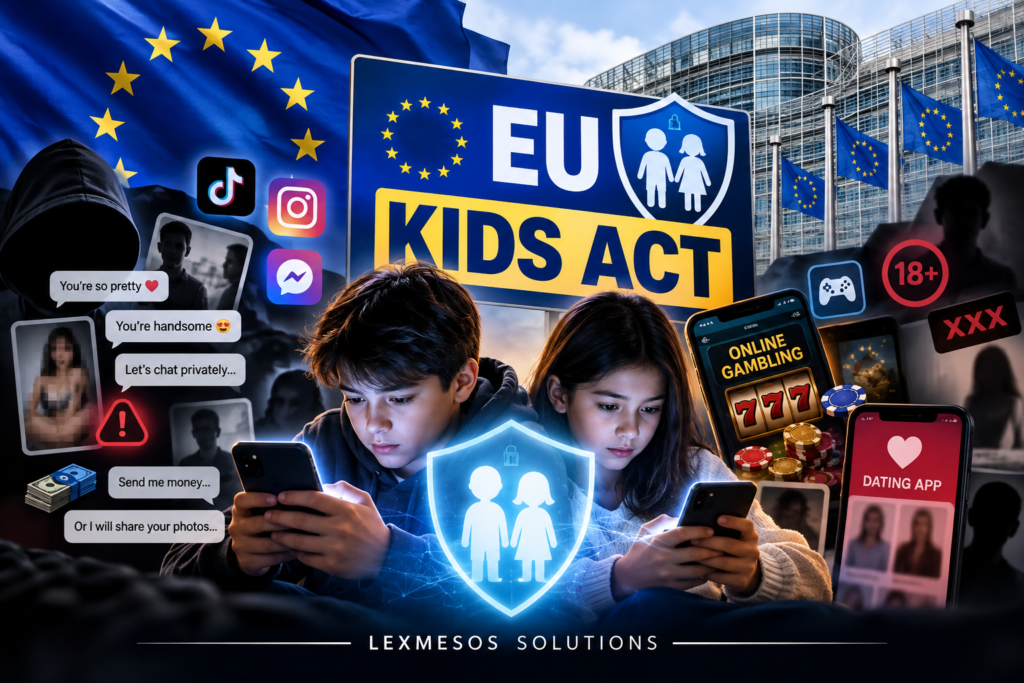
Children can access gambling and pornography, use dating apps, communicate with strangers and even be manipulated into sending intimate photos or money. As the EU considers stronger online safety rules, one question remains: will these laws protect children in real life?
What are children really doing online?
A child sits quietly in their bedroom, holding a smartphone.
Their parents assume they are watching TikTok, chatting with friends or playing games.
But what if they are doing something else?
What if they are visiting gambling websites, watching pornography, using dating apps or talking privately to strangers?
And what if someone they met online has already persuaded them to send money or intimate photographs?
These are uncomfortable questions, but they deserve attention.
One parent shared that their child had spoken about other children accessing adult websites, using dating apps and providing false ages or identification details to get around restrictions.
These are second-hand accounts, not verified findings about how common such behaviour is. Nevertheless, they illustrate the kinds of concerns parents may only discover through conversations with their children.
Many working parents cannot monitor everything their children do online. Even when parents restrict a child’s own phone, that child may still use a parent’s device, a friend’s phone or another account.
The internet has become part of childhood. But being able to use technology does not mean a child understands the risks.
1. What is the EU Kids Act?
The European Commission is consulting on a proposed EU Kids Act, intended to strengthen children’s protection in digital spaces.
The initiative is concerned with the responsibilities of online services, the risks children encounter and whether existing safeguards are sufficient.
It is important to distinguish the proposed EU Kids Act from existing EU legislation, particularly the Digital Services Act (DSA), which already imposes obligations on online platforms concerning illegal content, transparency and the protection of minors.
The EU Kids Act should not be described as an existing law or as a final set of rules. The precise obligations will depend on the legislative process.
The broader question behind the initiative is straightforward:
How can online services be made safer for children, rather than expecting parents and children to manage every risk themselves?
Official consultation: European Commission – EU Kids Act
2. Age restrictions sound simple. Getting around them can be simple too.
Imagine a website asking:
Are you over 18?
A child clicks “Yes”.
Or the website requests a date of birth, and the child enters a different year.
Some children may also attempt to use false identification details or another person’s account.
This is why an age restriction is not the same thing as effective age verification.
Stronger verification methods may reduce access by underage users. But they also raise questions about privacy, personal data and how identification is handled.
There is another practical problem.
A child may be unable to create an account independently but still access content through a parent’s unlocked phone.
No verification system can completely eliminate that possibility.
The challenge for lawmakers is to reduce children’s exposure to harmful services without creating excessive surveillance or requiring everyone to surrender sensitive personal information.
3. Pornography and gambling: what happens when children enter adult spaces?
Social media receives considerable attention in discussions about online safety.
But the internet is much larger than TikTok, Instagram or Facebook.
Children may also encounter pornography websites, online casinos, betting platforms and games with gambling-like features.
Some websites are restricted to adults, but the effectiveness of those restrictions depends on how access is checked and enforced.
A warning screen is unlikely to stop a determined child.
Online gambling presents financial risks. Children may not understand how quickly money can be lost, particularly when payment methods are connected to a device or account.
Games raise a related but distinct issue.
Not every in-game purchase is gambling. However, some games use randomised rewards, repeated purchase prompts or other features that encourage spending.
Parents may only discover the problem after seeing unexpected charges.
This raises an important question:
Should online services be required to prevent children from accessing inappropriate content and making unauthorised purchases, rather than simply displaying warnings?
4. Dating apps and strangers pretending to be someone else
Some children may also attempt to access dating apps by entering false ages.
This creates risks beyond exposure to inappropriate content.
A person claiming to be 15 might actually be an adult.
A profile picture may be stolen. A name may be false. An online identity may be completely fabricated.
Children who are still learning about relationships and personal boundaries may find it difficult to recognise manipulation.
The same problem can arise on ordinary social media platforms.
Someone does not need a dating app to approach a child.
Sometimes, all it takes is a comment beneath a photograph.
5. “You’re beautiful.” When a compliment becomes a trap
A child posts a photograph or video on TikTok or Instagram.
Someone comments:
“You’re so pretty.”
Or:
“You’re handsome.”
The child feels flattered.
The stranger starts a private conversation. They may claim to be the same age, share personal stories and gradually build trust.
At first, nothing seems unusual.
Then the conversation changes.
The person may ask for private information, money or intimate photographs.
Some children may send images because they believe they are talking to someone they trust. Others may feel pressured, manipulated or afraid of losing the relationship.
The situation can become much more serious when the person threatens to share those photographs unless the child pays money or sends more images.
This is known as sextortion, a form of blackmail involving intimate images.
Children can also be targeted through fake romantic relationships, impersonation and other scams.
The important point is that the danger does not necessarily begin with a suspicious website.
It may begin with an ordinary social media post and a seemingly harmless compliment.
6. When intimate photos become a tool for blackmail
Children who share intimate images may not understand how easily those images can be saved, copied or distributed.
A photograph sent privately can later be used to threaten or control them.
An offender might demand money, more images or continued contact.
Some children may be too frightened or embarrassed to tell anyone.
They may fear being punished by their parents, judged by their friends or blamed for sending the images.
This is why adult responses matter.
A child who has been manipulated or threatened needs protection and support, not humiliation.
Parents and schools should make clear that children can ask for help without being shamed.
If a child is being threatened, they should stop engaging with the offender, avoid sending further images or payments, preserve relevant evidence where safe and seek help from a trusted adult and the appropriate authorities.
No child should have to manage sexual blackmail alone.
7. Parents are working. They cannot watch every screen.
It is easy to tell parents to monitor their children.
In reality, many parents work full-time, manage households and have other responsibilities.
They cannot sit beside their children every time a phone is used.
Parental control apps can help by blocking certain websites, restricting app downloads, limiting spending and providing alerts.
But not every family knows how to configure these tools.
Some features cost money. Others are difficult to understand. And restrictions on one device may not apply to another.
This raises a practical question for policymakers:
Why should protecting children online depend so heavily on how much time, money or technical knowledge their parents have?
Online services should make safety features easier to find and use.
Default protections for younger users, restrictions on contact from unknown adults, spending controls and clear reporting systems could reduce risks before parents discover a problem.
These measures would not eliminate every danger, but they could make harmful interactions harder to initiate.
8. What does the EU Kids Act actually propose to change?
The EU Kids Act is more than a proposal to stop young children from opening social media accounts.
Published by the European Commission on 17 September 2026, it proposes four main areas of protection: delaying independent social media access, making digital services safer by design, improving age checks and parental controls and strengthening enforcement. (European Commission)
Under the proposed age rules:
| Age | Proposed social media access |
|---|---|
| Under 13 | No social media access, with limited exceptions for parent-managed child-friendly video services |
| 13–14 | Parent-managed accounts with restricted features and a one-hour daily limit |
| 15 and above | Independent accounts, subject to safety protections |
The proposal also includes private profiles by default, restrictions on unwanted contact from strangers, easier blocking and reporting and safeguards against features designed to encourage excessive use. (European Commission)
These details matter because several of the dangers discussed in this article are already recognised by the EU.
For example, restricting unsolicited contact from strangers could help reduce opportunities for online grooming. Stronger age checks could make it harder for children to register for inappropriate services.
But the real question is how well these measures will work once implemented.
Will platforms detect adults pretending to be teenagers? Will children be able to bypass restrictions through shared devices? Will complaints about blackmail receive immediate attention?
A safety feature is only useful when it works in practice.
9. What about pornography and gambling websites outside social media?
This is an important distinction.
The proposed EU Kids Act is not the EU’s only measure for protecting children online.
The EU already has the Digital Services Act, while the European Commission has also developed an age-verification approach for adult-restricted services, including pornography and gambling websites.
The aim is to allow users to prove they meet an age requirement without unnecessarily revealing their identity or personal details. (European Commission)
However, regulation becomes more difficult when services operate across borders, users provide false information or children access adult accounts.
The challenge is therefore not simply to introduce another age limit.
It is to ensure that different protections work together, across social media, gaming, adult websites, app stores and other digital services.
10. What can Malaysia learn from the EU?
Malaysia is dealing with similar concerns.
The Online Safety Act 2025 (Act 866) came into force on 1 January 2026, introducing responsibilities for covered online service providers to address online harms and protect users, particularly children. (MCMC)
On 1 June 2026, Malaysia’s Child Protection Code and Risk Mitigation Code also came into force. (MCMC)
Under the Child Protection Code, licensed social media service providers must implement age-verification measures, with users under 16 restricted from holding social media accounts. (MCMC)
The EU and Malaysia therefore share a common concern, although their legal frameworks and age thresholds differ.
Both must confront practical difficulties: false ages, shared devices, harmful content, suspicious private messages and the financial exploitation of children.
Neither age verification nor parental supervision can solve every problem.
What matters is whether online services are designed to reduce these risks, whether companies respond effectively to reports and whether regulators can enforce the rules.
Malaysia should also pay attention to the EU’s approach to privacy-preserving age checks. Children’s safety is important, but so is protecting the personal information collected to verify their ages.
11. Schools and psychological support also matter
A child who is being manipulated online may behave differently at school or at home.
They might become withdrawn, anxious or frightened of someone seeing their messages. Others may not show any obvious signs.
Parents and teachers cannot be expected to recognise every case.
This is why children need opportunities to speak openly about what happens online.
Schools can teach students how to recognise fake accounts, suspicious requests for money, inappropriate messages and attempts to obtain private photographs.
Psychological support may also help children who have experienced manipulation, bullying, threats or blackmail.
Most importantly, children should understand that they can ask for help even if they have made a mistake.
Fear of being punished should never be the reason a child stays silent about online exploitation.
12. Who should be responsible for children’s online safety?
Parents have responsibilities, but they cannot monitor every conversation.
Schools can educate children, but they cannot control every device.
Governments can make laws, but they cannot personally supervise millions of online interactions.
And children, especially younger ones, should not be expected to identify every scam, fake identity or attempt at manipulation.
Online companies therefore have an important role.
They control how accounts are created, who can contact whom, what content is recommended, how payments are processed and how suspicious behaviour is reported.
The EU Kids Act proposes shifting more responsibility towards these service providers.
But effective protection will require cooperation between platforms, regulators, parents, schools and the children themselves.
It also requires recognising that children need guidance and support, not simply restrictions.
Conclusion: The danger is not always what children watch. Sometimes, it is who is watching them.
A child may start by watching a video, playing a game or posting a photograph.
Then someone sends a compliment.
A private conversation begins.
The stranger gains the child’s trust, asks for money or private images, and may eventually use threats or blackmail.
Meanwhile, parents may have no idea that anything is happening.
This is why the discussion about the EU Kids Act needs to go beyond social media age limits.
Children face different risks across different online services, from pornography and gambling to financial scams, grooming and sextortion.
The EU is proposing stronger safeguards, but no law can guarantee complete protection.
The real measure of success will be whether children face fewer opportunities for exploitation, whether suspicious behaviour is stopped earlier and whether help is available when something goes wrong.
Because protecting children online is not simply about stopping them from opening an account. It is about protecting them from what can happen after they go online.
Publication note- 9 October 2026: The EU Kids Act remains a proposal, not an enacted regulation. The European Commission is collecting public feedback. Its official pages currently display conflicting closing dates of 26 November and 3 December 2026, so readers should check the consultation portal for the applicable deadline.
Keywords: EU Kids Act, EU children’s online safety, social media age restrictions, child online grooming, sextortion, online gambling risks, pornography age verification, dating apps and minors, parental controls, online scams targeting children, Malaysia Online Safety Act 2025, child protection and digital platform accountability
Official sources for publication: European Commission- EU Kids Act proposal; EU approach to age verification; and full proposed regulation on EUR-Lex.
9 October 2026