 Skip to content

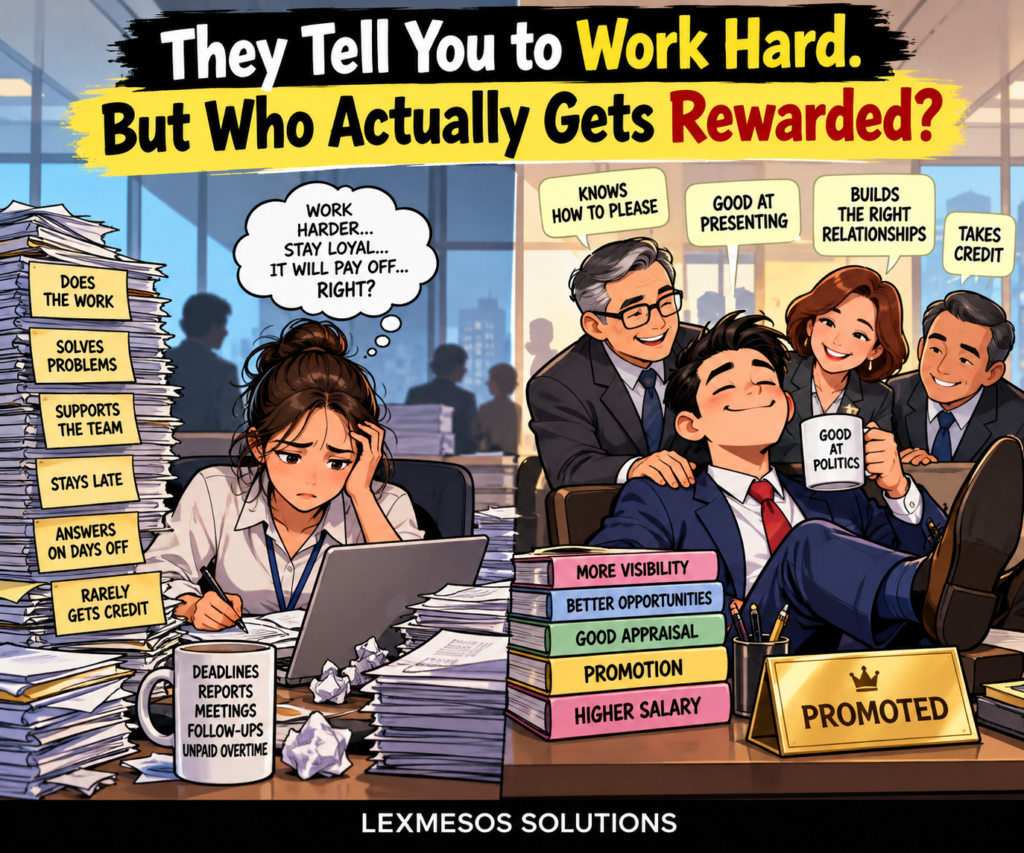
Some people work hard. Others work hard at looking important. Guess who gets noticed?
The World Belongs to Bad People. Or Does It?
Someone once said something rather disturbing:
“This world belongs to bad people. They know how to manipulate, cheat and enjoy life, while good people work hard and suffer.”
It sounds terribly pessimistic.
But anyone who has spent enough time in the corporate world may understand why someone would feel that way.
One employee arrives early, handles difficult assignments, solves problems, answers messages after working hours and struggles to meet deadlines.
Another spends more time building relationships with senior management, attending meetings, presenting achievements and making sure the right people notice them.
When promotion season arrives, who gets recognised?
Sometimes, it is not the person who did the most work.
It is the person who made the strongest impression.
Welcome to the corporate world, where being seen working can sometimes be more rewarding than actually doing the work.
The Loudest Person in the Room Isn’t Always the Hardest Worker
Every workplace seems to have someone who knows how to command attention.
They speak confidently during meetings. They always have something to say. They know when to agree with senior management and how to make their contributions sound impressive.
Then there are employees who prefer to concentrate on their responsibilities.
They complete assignments, solve problems, support colleagues and keep operations running.
They may not constantly announce their achievements.
And that can become a disadvantage.
Because in some organisations, visibility is mistaken for value.
The employee who spends hours resolving a complicated problem may receive little recognition. But someone who confidently presents the outcome at a management meeting may become the face of that success.
Of course, speaking confidently is not a weakness. Communication and presentation skills are important professional abilities.
The problem begins when companies confuse the ability to present results with responsibility for producing them.
Some people spend their time doing the work. Others spend their time making sure everyone thinks they did the work.
And if management cannot tell the difference, the wrong people may be rewarded.
Some Managers Manage. Others Just Have the Title.
A managerial title should represent responsibility, judgement and leadership.
But does it always?
Some employees have experienced managers who struggle to make decisions, lack the necessary technical knowledge or depend almost entirely on their subordinates to resolve problems.
When a difficult issue arises, they pass it down.
When a decision is required, they ask someone else to prepare the answer.
When something goes wrong, the employee who performed the work may be questioned.
But when the outcome is successful, the achievement may be presented as management’s accomplishment.
Meanwhile, the manager continues enjoying the title, salary and benefits.
This is not about how many hours a manager spends at a desk. Effective management does not require someone to personally complete every assignment or remain in the office longer than everyone else.
Good managers delegate appropriately, remove obstacles, make decisions, develop employees and accept accountability.
But there is a significant difference between delegation and simply transferring responsibility to subordinates.
If employees must do the thinking, solve the problems, make the recommendations and carry the consequences, what exactly is management contributing?
That is a question companies should be willing to ask.
Work Hard and You’ll Succeed. Really?
Social media is full of motivational advice.
Work hard.
Stay focused.
Believe in yourself.
Never give up.
And eventually, success will come.
It sounds wonderful.
But the real world is more complicated.
Hard work can improve skills, create opportunities and contribute to professional success.
Yet hard work alone does not guarantee promotion, financial security or recognition.
Employees also operate within systems shaped by management decisions, organisational politics, access to opportunities and personal relationships.
Two people may contribute very differently but receive very different rewards.
One may consistently deliver excellent results while remaining largely invisible to senior management.
Another may be particularly skilled at building influential relationships and presenting themselves as indispensable.
Sometimes, the second person advances faster.
That does not mean every successful person is dishonest or every overlooked employee is exceptionally capable.
It means career outcomes are not always a straightforward reflection of effort.
Hard work matters. But who notices the work, who receives the credit and who makes the promotion decisions can matter too.
Perhaps motivational speakers should mention that part occasionally.
The Art of Pleasing the Right People
Some people understand office politics extremely well.
They know whom to approach, when to offer compliments, which meetings to attend and how to remain visible to decision-makers.
They are skilled at making senior management feel supported and appreciated.
There is nothing inherently wrong with building professional relationships.
The problem arises when pleasing the right people becomes more important than performing the actual job.
An employee who challenges a poor decision may be labelled difficult.
Another who agrees enthusiastically with management may be considered cooperative.
One raises concerns about unrealistic deadlines.
Another promises that everything can be completed, then relies on colleagues to make it happen.
Who appears more positive?
Who seems easier to manage?
And who may receive the better performance rating?
A company that rewards agreement more than sound judgement may eventually surround itself with people who are excellent at saying yes but reluctant to say when something is wrong.
That is not merely an employee relations issue.
It is a management and governance risk.
Performance Review Season: When Everyone Suddenly Becomes Friendly
There is another amusing feature of corporate life.
Throughout the year, employees may feel pressure to impress their managers.
They accept additional assignments, respond to messages during personal time and try to remain available even on their days off.
Why?
Because their manager may influence their performance rating, bonus, salary increase or promotion.
Sometimes the pressure is explicit.
Sometimes nobody says anything at all.
Employees simply understand that being seen as helpful and committed may improve their prospects.
Then comes the season of upward feedback or 360-degree performance reviews.
Suddenly, some managers become noticeably more approachable.
They ask how everyone is doing.
They listen more carefully.
They show greater interest in employee wellbeing.
They may even become unusually friendly.
What a wonderful transformation!
Of course, many managers genuinely care about their teams throughout the year. And there is nothing wrong with improving one’s leadership behaviour.
But when the change appears only around feedback season, employees may wonder whether the friendliness is genuine or simply another form of impression management.
Employees spend the year trying to impress their managers. Some managers spend appraisal season trying to impress their employees.
The real question is whether a company’s performance system can distinguish consistent behaviour from temporary appearances.
When Loyalty Means Giving Up Your Personal Time
Consider an employee enjoying a day off.
Their manager sends a message requesting assistance with something urgent.
The employee responds.
Then another request arrives.
And another.
Before long, part of the employee’s personal day has disappeared.
Why not simply refuse?
Because employees may worry that refusing will affect how their manager views their commitment.
They may fear being described as unhelpful, inflexible or lacking a team spirit.
Some may believe that sacrificing personal time is necessary to secure a good appraisal.
Yet the employee who establishes reasonable boundaries may be judged less favourably than someone who is constantly available.
That creates an uncomfortable question.
Are companies rewarding employees for the quality of their work, or for how much of their personal lives they are willing to sacrifice?
Occasional emergencies happen, and some roles legitimately involve agreed on-call responsibilities.
But routine expectations of unpaid availability should not be disguised as dedication.
An employee can be committed, reliable and hardworking without surrendering every evening, weekend or holiday.
Professionalism should not require permanent availability.
When Personal Relationships Become Professional Advantages
Office relationships are another reality of corporate life.
Colleagues form friendships. Some develop romantic relationships. Others build close professional networks over many years.
There is nothing automatically improper about that.
But what happens when personal relationships influence decisions about promotions, performance ratings, assignments or disciplinary action?
What if one employee receives opportunities because of a close relationship with someone in authority?
What if another is excluded because they are not part of the same social circle?
And what if an employee rejects unwanted romantic or sexual advances from someone who has influence over their career?
If that refusal is followed by unfair treatment, threats, poor ratings or exclusion, the situation may go beyond favouritism and raise serious concerns about harassment, retaliation or abuse of power.
The precise legal consequences depend on the circumstances and applicable law.
But the ethical principle is straightforward.
Nobody should have to become someone’s favourite, friend or romantic partner to receive fair treatment at work.
Companies need clear conflict-of-interest rules, credible reporting channels and independent review where personal relationships may compromise employment decisions.
Otherwise, professional advancement risks becoming a question of who someone knows rather than what someone contributes.
HR Has the Policies. But Who Makes Sure They Work?
Most large organisations have impressive policies.
Codes of conduct.
Anti-harassment policies.
Performance management frameworks.
Whistleblowing procedures.
Employee wellbeing programmes.
Statements about fairness, integrity and equal opportunity.
The documents may look excellent.
But what happens when the people responsible for applying them fail to act?
What happens when an employee raises concerns about unfair treatment but receives no meaningful response?
What happens when managers consistently receive positive assessments despite repeated concerns about their leadership?
And what happens when the employees doing the most work are repeatedly overlooked?
HR does not necessarily have the power to overturn every management decision. Nor does every employee complaint prove misconduct.
But a credible system should allow concerns to be examined fairly, decisions to be supported by evidence and conflicts of interest to be addressed.
Simply having a policy does not establish that the policy works.
A company can have excellent HR policies and still have a serious accountability problem.
The real test is what happens when those policies must be applied to someone with influence.
Why Do Companies Keep Rewarding the Wrong Behaviour?
This is where the discussion becomes more important than individual personalities.
If employees believe that flattering management produces better results than delivering quality work, some will naturally concentrate on visibility.
If managers are rewarded for short-term outcomes without examining how those outcomes were achieved, they may have little incentive to develop their teams properly.
If promotions depend heavily on personal impressions, quieter employees may be overlooked.
And if senior leadership rarely examines the quality of management decisions, poor practices can continue for years.
Over time, employees learn what the organisation truly values.
Not what appears on the company website.
Not what HR says during orientation.
But what the company actually rewards.
Corporate culture is revealed not only by what an organisation says it believes, but by the behaviour it tolerates and promotes.
If taking credit for other people’s work leads to recognition, employees notice.
If raising concerns damages careers, employees notice.
If capable workers are repeatedly overloaded while underperforming managers face no consequences, employees notice that too.
And eventually, some stop trying.
Others leave.
The company may then wonder why employee engagement is declining.
So, Should Good People Stop Working Hard?
Absolutely not.
Being competent, honest and responsible still matters.
But there is a difference between working hard and allowing yourself to be endlessly exploited.
Employees should be able to demonstrate their contributions, communicate achievements and establish reasonable professional boundaries.
Quietly doing excellent work should not mean remaining invisible forever.
At the same time, companies must recognise that the responsibility cannot rest entirely with employees.
It is management’s job to create fair systems for evaluating performance, recognising contributions and making promotion decisions.
That means looking beyond confident presentations and personal relationships.
Who actually delivered the results?
Who solved the difficult problems?
Who supported the team?
Who made sound decisions?
Who accepted responsibility when things went wrong?
And who merely appeared when it was time to take the credit?
These questions may be less comfortable than asking employees to work harder.
But they are far more useful.
Perhaps the Problem Isn’t That Good People Cannot Succeed
Let’s return to the statement that started this discussion:
“This world belongs to bad people.”
It is easy to understand the frustration behind those words.
When someone works hard, behaves responsibly and still struggles, while others appear to advance through manipulation or favouritism, the world can seem terribly unfair.
But perhaps the issue is not that bad people always win.
Perhaps it is that some organisations are not particularly good at distinguishing genuine contribution from carefully managed appearances.
And that is something companies can change.
They can demand evidence of performance rather than relying solely on impressions.
They can assess managers on leadership quality, not just departmental results.
They can make promotion decisions more transparent.
They can protect employees who raise legitimate concerns.
And they can stop treating personal sacrifice as the ultimate measure of commitment.
Because a healthy workplace should not require employees to choose between being good at their jobs and being good at office politics.
Nor should it reward those who know how to impress management while overlooking the people keeping the business running.
The loudest voice in the room is not always the most capable.
The most visible employee is not always the most productive.
And the person receiving the credit is not always the person who did the work.
So perhaps the next time a company celebrates another promotion, it should ask one simple question:
“Did we promote the person who delivered the results, or the person who was best at taking credit for them?”
Because if an organisation cannot tell the difference, the problem is not that its employees need to work harder.
The problem is that its leadership needs to look harder.
Keywords: Hard work and workplace favouritism, office politics, unfair promotions, incompetent managers, workplace inequality, employee recognition, toxic management, corporate favouritism, workplace manipulation, unfair performance appraisals, workplace harassment, abuse of managerial power, office relationships and conflicts of interest, employee exploitation, workplace stress, poor leadership, HR accountability, corporate governance, employee burnout, career advancement, workplace ethics, employee performance, workplace discrimination, management accountability, employee loyalty, work-life balance, and unfair treatment at work
17 October 2026