 Skip to content

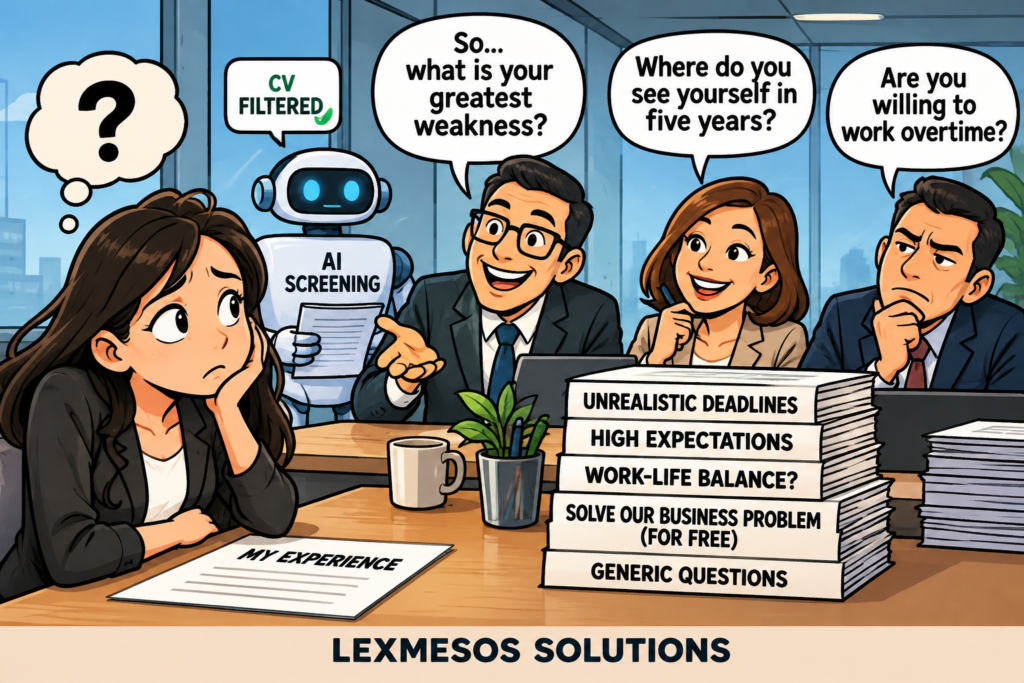
AI screens the CV. The interviewer asks about strengths, weaknesses and five-year plans. But who is evaluating the quality of the recruitment process?
Welcome to the Modern Job Interview
Companies have never had so many recruitment tools at their disposal.
Applicant tracking systems, automated CV screening, online assessments, video interviews and artificial intelligence are increasingly part of the hiring process.
Yet after all that technology, a candidate may finally sit down with an interviewer and hear the same familiar questions:
“What are your strengths and weaknesses?”
“Where do you see yourself in five years?”
“How do you prioritise your tasks?”
“How do you handle pressure?”
“Are you willing to work overtime?”
Some of these questions have been asked for decades.
And candidates have spent decades learning how to answer them.
Now, with AI helping people prepare polished interview responses, perhaps we should ask a different question.
Are companies genuinely assessing professional competence or simply testing how well candidates have rehearsed their answers?
AI Screens the CV. But Who Screens the AI?
Imagine someone with 20 years of professional experience.
They have managed departments, negotiated complicated agreements, handled commercial disputes, supervised employees and made difficult business decisions.
But before anyone speaks to them, their application may pass through an automated recruitment system.
Depending on how the system is designed, candidates may be ranked, filtered or assessed against particular criteria.
That can make recruitment more efficient, especially when hundreds of applications arrive for one vacancy.
But efficiency is not necessarily accuracy.
What if an experienced professional uses different terminology from the job advertisement? What if their experience crosses several industries? What if their achievements cannot be captured neatly through predefined keywords?
A poorly designed screening process may overlook relevant experience.
Not every applicant tracking system uses AI, and not every automated system rejects candidates without human involvement. Nevertheless, employers should understand how their recruitment technology works and whether it is producing fair, reliable results.
There is something rather ironic about a company seeking experienced professionals while relying on a screening process that may not fully recognise experience.
Technology should help recruiters identify talent, not become another obstacle between talent and opportunity.
“What Are Your Strengths and Weaknesses?”
Ah, the classic interview question.
Almost everyone has heard it.
And almost everyone knows the familiar answers.
“My weakness is that I’m a perfectionist.”
“I sometimes work too hard.”
“I care too much about getting things right.”
Then comes the follow-up:
“How do you overcome your weakness?”
Naturally, the candidate explains how they have developed greater self-awareness, improved their time management or learned to delegate.
The interviewer nods.
The candidate smiles.
Everyone has played their part.
But what has the company actually learned?
Self-awareness is valuable. The ability to recognise and improve weaknesses matters in almost every profession.
However, a polished answer is not necessarily evidence of genuine self-awareness.
For an experienced professional, wouldn’t it be more meaningful to discuss a difficult decision they made, an unsuccessful project they managed or a mistake they learned from?
Those conversations reveal judgement, accountability and practical experience.
A rehearsed description of someone’s greatest weakness may reveal little more than their interview preparation.
“Where Do You See Yourself in Five Years?”
This question sounds harmless enough.
But think about what it asks.
A candidate is expected to describe their future within an organisation they have not even joined.
Five years is a long time in business.
Companies restructure. Management changes. Departments merge. Technology replaces certain tasks. Business strategies evolve.
Some companies expand. Others downsize.
Yet the candidate is expected to present a confident five-year career plan.
What if someone is an experienced professional who enjoys their work and has no particular desire to become a director?
Must everyone aspire to climb the corporate ladder?
Professional development does not always mean promotion. It may mean developing deeper expertise, mentoring colleagues, improving systems or becoming exceptionally good at a particular role.
And if employers expect candidates to explain their five-year commitment, perhaps they should be prepared to explain their own plans for employee development.
Where does the company see its employees in five years?
That question deserves an answer too.
“How Will You Help Our Company Achieve Its Goals?”
Another familiar question.
Of course, employers want people who can contribute to business objectives.
There is nothing unreasonable about that.
But how much does an external candidate actually know about the company’s internal challenges?
They may have studied its website, annual reports, public announcements and business activities.
They may understand the industry and possess substantial professional experience.
But they do not necessarily know the company’s internal resources, operational weaknesses, management disagreements or financial constraints.
An experienced candidate can explain how their expertise may contribute to the organisation.
What they cannot responsibly do is guarantee solutions to problems they have not yet examined.
The better conversation would explore the company’s actual priorities, what success looks like and what resources would be available to the person taking the role.
After all, achieving business objectives is not solely an employee’s responsibility.
It requires leadership, resources, communication and organisational support.
“How Do You Prioritise Your Tasks?”
This is another popular question, particularly for experienced professionals and management candidates.
The expected answer often involves organising tasks according to urgency, importance and deadlines.
Fair enough.
But let’s consider a practical situation.
Three departments need something completed urgently.
All three insist their work is the highest priority.
All three expect delivery tomorrow.
Who decides which assignment comes first?
An employee can assess urgency, consequences and available time. A manager may have broader authority to allocate resources and determine priorities.
But where different departments have conflicting demands, the decision may require agreement between the relevant managers or escalation to senior management.
Time management is an individual skill. Workload management is also an organisational responsibility.
And when companies interview senior managers, wouldn’t it be more useful to explore how they resolve competing business priorities, allocate resources and manage risk?
Asking a senior executive how they organise a daily to-do list may not tell the employer very much about their leadership ability.
The question is not necessarily wrong.
The problem is asking it without considering the seniority and responsibilities of the position.
“Assigned Today. Deadline Tomorrow. What Would You Do?”
Now imagine an interviewer presents this scenario:
You receive an assignment today. It must be completed tomorrow. You realise the deadline is unrealistic.
What would you do?
One suggested solution might be to ask colleagues for help.
That sounds collaborative.
But what if those colleagues already have their own deadlines?
What if they report to different managers?
What if the employee has no authority to redistribute work?
In a large organisation, responsibilities and reporting lines exist for a reason.
Employees should communicate problems early, assess what can reasonably be completed and propose solutions.
But when additional resources or changes to priorities are required, the appropriate manager should be involved.
A specialist does not automatically possess managerial authority simply because a deadline is approaching.
And there is another question.
If the task was assigned today and is due tomorrow, did anyone assess whether the deadline was realistic before assigning it?
Urgent work sometimes happens. Emergencies are part of business.
But the existence of an urgent deadline does not eliminate the need for planning, resources or professional judgement.
Sometimes the best response is not to promise the impossible.
It is to explain the risks and agree on a realistic way forward.
“We Believe in Work-Life Balance. Are You Willing to Work Overtime?”
Perhaps this is one of the most revealing contradictions in recruitment.
A company promotes employee wellbeing, flexible working and work-life balance.
Then, during the interview, the candidate is asked whether they can work overtime, manage constant pressure or respond to last-minute requests.
There is nothing inherently wrong with asking about occasional overtime where it is genuinely part of the role, lawfully managed and clearly explained.
Some industries operate around emergencies, international time zones, critical services or unpredictable commercial events.
The issue is transparency and consistency.
If a company promotes a culture of avoiding overtime, how does it manage urgent work when the team is already at full capacity?
Does management reprioritise assignments?
Are deadlines renegotiated?
Are additional resources provided?
Or is the expectation that employees will somehow finish everything without affecting their personal time?
Work-life balance is not simply a statement in a recruitment advertisement. It depends on how work is actually planned and managed.
An interview should help clarify those expectations, not leave candidates guessing.
When an Interview Becomes Free Consultancy
There is another uncomfortable situation that experienced professionals may recognise.
An interviewer presents a highly specific business problem and expects the candidate to provide an immediate solution.
Realistic case studies can be excellent assessment tools.
They allow employers to evaluate technical knowledge, commercial judgement and problem-solving ability.
But there is an important difference between testing someone’s approach and asking them to resolve an actual business issue during an interview.
Some matters require access to confidential documents, a full understanding of the facts, proper analysis and time to consider the consequences.
A responsible professional may explain that they cannot provide a definitive recommendation without reviewing the relevant information.
That should not automatically be interpreted as a lack of competence.
In many professions, knowing when more information is required is part of professional competence.
Employers should also be careful not to turn recruitment exercises into requests for unpaid, usable professional work.
An interview is supposed to assess expertise, not replace the engagement of an expert.
Experienced Candidates Deserve Experienced Interviewing
There is a difference between interviewing a graduate and interviewing someone who has spent decades managing people, projects, contracts or business operations.
That does not mean senior candidates should be exempt from scrutiny.
Quite the opposite.
The greater the responsibility, the more important it becomes to examine professional judgement, leadership, ethics and decision-making.
But the questions should reflect the level of the position.
A senior manager may be better assessed through discussions about difficult decisions, competing commercial priorities, team performance, governance failures or managing uncertainty.
An experienced technical professional may be better assessed through their approach to complex problems, risk identification and professional standards.
Generic questions can still be useful as introductions.
But if the entire interview consists of textbook questions, the employer may learn very little about what the candidate can actually do.
And if an interviewer does not fully understand the responsibilities or authority attached to the position, how effectively can they assess the person applying for it?
Recruitment Technology Has Advanced. Has Interviewing?
Modern recruitment has become increasingly sophisticated.
Companies invest in employer branding, automated screening, assessments, recruitment software and AI tools.
Candidates, meanwhile, can use AI to improve their CVs, prepare interview answers and practise common questions.
We may now have AI-assisted applications being assessed by AI-assisted recruitment processes, followed by interviews filled with questions whose answers are widely available online.
It is almost comical.
But behind the humour lies a serious issue.
If everyone knows the expected answers, how much does the interview reveal about real competence?
A confident speaker is not necessarily a capable manager.
Someone who gives an imperfect answer may nevertheless possess exceptional judgement and experience.
A candidate who challenges an unrealistic assumption may be demonstrating the very independence of thought that the employer needs.
Good recruitment should distinguish between performance during an interview and performance in the job.
That requires well-designed assessments, trained interviewers and a clear understanding of what the role actually demands.
AI can support the process, but it cannot excuse poor recruitment judgement.
Perhaps the Interviewer Should Be Asking Different Questions
Companies understandably want employees who are reliable, adaptable, capable and committed.
Candidates understandably want fair treatment, realistic expectations, opportunities to contribute and employers who practise what they advertise.
Those interests are not necessarily in conflict.
But recruitment works best when both sides can discuss them openly.
Instead of relying entirely on predictable questions, interviewers could explore how candidates have handled real challenges, made difficult decisions, worked through disagreements and responded when things went wrong.
Employers should also be prepared to explain their own decision-making processes, management support, workload expectations and professional development opportunities.
A candidate’s answer to an interview question may reveal something about the candidate.
But the question itself may reveal something about the company.
So, Who Is Really Being Interviewed?
A job interview is not an examination in which one party holds all the answers.
It is a conversation between an organisation seeking expertise and a professional considering whether to contribute that expertise.
Both sides have something to evaluate.
A company may reject a candidate because an answer did not meet its expectations.
But a candidate may also leave an interview questioning whether the employer understands the role, respects professional boundaries or manages its people effectively.
And that is worth remembering in an age when companies are increasingly concerned about attracting and retaining talent.
Before asking candidates where they see themselves in five years, perhaps companies should ask what kind of workplace they are inviting those candidates to join.
Because sometimes, the most revealing part of a job interview is not the answer.
It is the question.
Keywords: Job interview questions, outdated interview questions, AI recruitment screening, artificial intelligence in hiring, recruitment culture, employer red flags, unrealistic workplace expectations, work-life balance, senior management interviews, interview mistakes, hiring practices, recruitment bias, candidate assessment, HR recruitment practices, interviewer training, workplace management, corporate governance, employee expectations, professional experience, recruitment transparency, and responsible AI recruitment
17 October 2026