 Skip to content

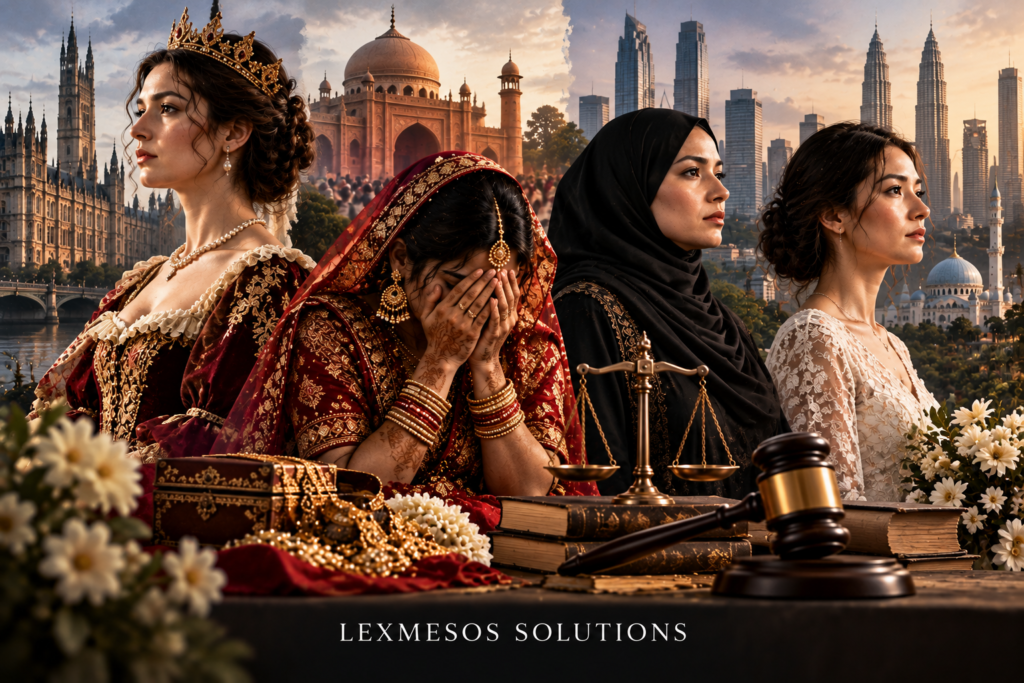
An 11-year-old bride. Thousands of dowry-related deaths. Marriage laws that still permit exceptions for minors. When family traditions collide with individual rights, who is actually being protected?
An 11-Year-Old Bride. In 2026, We Are Still Having This Conversation.
An 11-year-old Iraqi girl married to a 17-year-old boy.
A 14-year-old Afghan girl married to a 30-year-old man.
A 12-year-old Afghan girl married to a 21-year-old man.
These are not stories from the distant past.
On 13 October 2026, Euronews reported that 358 marriages involving minors had been recorded in Baden-Württemberg, Germany, since 2012. Only eight had resulted in legally final annulments. (Euronews)
Before anyone jumps to conclusions, there is an important distinction.
The marriages concerned were contracted abroad and subsequently came before German authorities. The figures do not mean that 358 child marriages were performed in Germany, nor do they establish that the practice is widespread among German citizens.
According to the report, the cases involved people of various nationalities, including Iraqi, Afghan and Syrian nationals.
Germany generally requires both individuals to be at least 18 years old to marry. Nevertheless, marriages contracted in other countries can create difficult legal questions when the individuals subsequently reside in Germany.
What should happen when a marriage considered permissible under one country’s legal system conflicts with another country’s child-protection standards?
Should the marriage be annulled automatically?
What happens to the minor’s financial support, housing and other legal protections?
And perhaps the most important question: who asked the child whether she wanted to be married in the first place?
The remaining 350 recorded cases were concluded through other means, including a spouse reaching adulthood, a decision not to pursue annulment or other circumstances. This does not establish that all 350 marriages were legally recognised or continued.
Yet the small number of final annulments raises legitimate questions about how these cases were handled and what protections were available to the minors involved.
Germany’s Federal Constitutional Court had already highlighted a complication in 2023: automatically invalidating certain foreign child marriages without adequate safeguards could leave affected minors without important legal protections.
Germany subsequently revised its legislation in 2024 to address aspects of this problem.
The challenge is therefore not simply to declare a marriage invalid.
It is to protect the child without creating additional harm.
But why should an 11-year-old ever be placed in a position where marriage, separation, annulment and financial dependency become questions she must confront?
European marriage laws have continued to evolve since the European Union Agency for Fundamental Rights (FRA) published its 2017 research on minimum marriage ages and consent requirements. England and Wales raised the minimum marriage age to 18 in 2023, while Finland and Ireland abolished exemptions permitting underage marriages in 2019.
Following a 2023 Federal Constitutional Court ruling, Germany introduced legislative reforms in 2024 to strengthen legal protections for minors affected by marriages contracted abroad, including safeguards concerning maintenance and legal status. Meanwhile, Scotland launched a consultation in December 2025 on raising its minimum marriage age from 16 to 18.
These developments demonstrate that European marriage laws are not entirely uniform and that reforms remain ongoing. For further legal context, readers may refer to the European Union Agency for Fundamental Rights (FRA) and the German Bundestag’s 2024 legislative reform.
India Banned Dowry in 1961. In 2024, 5,737 Women Still Died in Dowry-Related Cases.
On 9 October 2026, France 24 published an investigation into India’s deeply entrenched dowry practices. (France 24)
The report cited 5,737 dowry-linked deaths in 2024, approximately 16 women every day.
Sixteen women.
Every single day.
India enacted the Dowry Prohibition Act 1961.
More than six decades later, dowry-related harassment, financial demands and violence remain serious problems.
Traditionally, dowry involves money, jewellery, vehicles, property or other valuables transferred or demanded from the bride’s family in connection with marriage.
In some cases, demands do not stop after the wedding.
A husband’s family may expect additional cash, luxury goods or property. Where those expectations are not met, some women experience intimidation, harassment, domestic violence or even death.
The law prohibits dowry demands, subject to its statutory definitions and exceptions for certain voluntary presents.
But the persistence of abuse raises a difficult question:
What is the value of a law if the people it is supposed to protect are still afraid to say no?
Consider the contradiction.
A woman may be educated, employed and financially independent.
Yet marriage-related expectations can still expose her or her family to financial pressure.
Her qualifications do not necessarily protect her from coercion.
Her family’s wealth does not necessarily guarantee her safety.
And a criminal prohibition does not automatically prevent harmful conduct behind closed doors.
Not every Indian marriage involves dowry, and it would be inaccurate to suggest otherwise. The issue is the continuing existence of coercive demands and abuse despite longstanding legal restrictions.
The France 24 investigation also highlights the social expectations surrounding marriage and the pressure some families face to provide expensive gifts.
This is where the problem becomes larger than the wording of a statute.
When a marriage begins with a financial demand, at what point does a supposed tradition become exploitation?
She Was Too Young to Consent, but Old Enough to Become Someone’s Wife
A child may be considered too young to vote, enter many binding transactions independently or make certain important decisions without adult assistance.
Yet some legal systems still permit marriage below 18, subject to exceptions, parental involvement or judicial approval.
This creates an uncomfortable contradiction.
Marriage is not a minor decision.
It can affect education, financial independence, living arrangements, sexual and reproductive autonomy, family responsibilities and future opportunities.
For an adult, these consequences can be significant.
For a child, they may be overwhelming.
The international child-rights framework generally treats marriage below 18 as child marriage, even though national laws differ in their minimum ages and exceptions.
Some defenders of underage marriage argue that family consent, religious traditions or judicial oversight provide sufficient safeguards.
Others contend that a child cannot exercise meaningful autonomy when faced with pressure from parents, guardians or older prospective spouses.
The legal question deserves careful consideration.
A parent’s approval may be relevant under domestic family law.
A court may have authority to grant an exception.
A religious ceremony may have been conducted according to a community’s traditions.
But does compliance with a procedure necessarily establish that the child was free to refuse?
A girl who fears disappointing her family may remain silent.
A girl who depends financially on her parents may feel unable to object.
A girl who has been raised to believe that refusing marriage brings shame may not understand that she has a genuine choice.
Silence should not automatically be mistaken for consent.
And a marriage certificate should not be treated as proof that coercion was absent.
Before We Judge Other Cultures, What About Europe’s Own History?
Child marriage was not exclusive to Asia, the Middle East or Muslim societies.
Medieval England had its own history of young brides, particularly among royal and aristocratic families, where marriage could secure political alliances, inheritance and dynastic power.
Lady Margaret Beaufort, mother of King Henry VII, married Edmund Tudor at just 12 years old and gave birth at 13. (The National Archives)
Under medieval English canon law, girls could generally marry at 12 and boys at 14. Marriages could be arranged earlier, although actual marriage and consummation did not necessarily occur together.
These arrangements were not representative of every medieval household, but they demonstrate that European history also contains examples of children being married for family and political interests.
Centuries ago, a girl’s marriage could be negotiated to protect a kingdom. Today, should any girl’s future still be negotiated to protect family honour, wealth or tradition?
The historical comparison matters because child marriage should not be portrayed as a problem belonging exclusively to particular religions or nationalities.
Societies have changed their laws and expectations over time.
The question is whether modern legal systems are willing to ensure that every child receives the protection those reforms were intended to provide.
Malaysia: Why Is 18 Still Not an Absolute Minimum Marriage Age?
Malaysia provides a particularly relevant comparison.
Marriage laws differ according to whether the parties are Muslim or non-Muslim.
For non-Muslims, the Law Reform (Marriage and Divorce) Act 1976 generally requires individuals to be at least 18 to marry.
However, the legislation provides a special-licence exception for girls aged 16 or 17.
For Muslims, marriage is governed by the applicable state Islamic family law.
In many Malaysian states, the statutory marriage ages have historically been 18 for males and 16 for females, with provisions allowing marriages below those ages subject to Syariah Court permission.
Some states have raised their minimum ages, but the position is not uniform throughout Malaysia.
The Malaysian government’s own guidance confirms that underage Muslim marriage applications require a court order under the relevant state law.
This means that Malaysia does not currently operate a single, exception-free minimum marriage age of 18 across all marriage systems.
The existence of a legal exception does not mean every application is approved.
Nor does it mean that every underage marriage involves coercion.
Nevertheless, it raises important policy questions.
Why should a 16-year-old girl be treated differently from a 16-year-old boy under certain marriage provisions?
Should parental agreement carry significant weight where the proposed marriage may affect the child’s education and long-term independence?
How should a court determine whether the child genuinely wants the marriage?
What safeguards exist where family members are the source of pressure?
And should a minimum marriage age remain a minimum if the law continues to permit exceptions below it?
These questions deserve examination regardless of whether the marriage is governed by civil law or Islamic family law.
The objective should be consistent protection of children rather than assumptions about any particular religious community.
Four Wives, Younger Brides and the Boundaries of Religious Marriage Laws
Another subject that frequently arises in discussions about Islamic family law is polygyny.
Traditional Islamic jurisprudence permits a Muslim man to marry up to four wives, subject to conditions concerning fairness and responsibilities.
However, this does not mean that every Muslim-majority country applies the same rules.
Some countries restrict or prohibit polygyny, while others regulate it through courts and statutory requirements.
In Malaysia, a Muslim man seeking to marry an additional wife is generally required to obtain Syariah Court approval.
The court considers matters including financial ability and fairness, in accordance with the applicable state law.
But two issues must be distinguished.
Polygyny concerns the number of spouses. Child marriage concerns the age of a spouse.
Permission to marry more than one wife does not automatically grant permission to marry a minor.
Similarly, the existence of polygyny in Islamic jurisprudence does not establish that Muslim men generally prefer younger brides.
These are different legal and social questions, and conflating them risks turning a serious discussion about rights into an unsupported generalisation.
What should be examined is whether the legal framework adequately protects all individuals affected.
Can a prospective wife freely refuse?
Are the legal interests of existing wives considered?
Can the husband fulfil his financial obligations?
Are all prospective spouses legally capable of consenting?
And if a proposed spouse is underage, should the law allow the marriage to proceed at all?
Religious freedom and cultural traditions are important.
But they must be considered alongside the rights to personal autonomy, equality and protection from coercion.
The real question is not simply how many wives a man may marry. It is whether every person entering the marriage has meaningful legal protection and freedom of choice.
Arranged Marriage Is Not the Same as Forced Marriage
This distinction is essential.
In many societies, families play an active role in introducing potential spouses or arranging marriages.
An arranged marriage is not necessarily a forced marriage.
Where both adults are free to accept or reject the proposed marriage, family involvement alone does not establish coercion.
Forced marriage is different.
It involves an absence of free and genuine consent, potentially arising from threats, intimidation, emotional manipulation, financial dependence or other forms of pressure.
A woman may be told that rejecting a proposed husband would disgrace her family.
A girl may be warned that she will lose financial support.
A prospective spouse may be threatened with violence or social exclusion.
Coercion does not always leave physical injuries.
Sometimes it operates through dependency, fear and the expectation of obedience.
And this is why asking whether a marriage was formally registered is not enough.
Authorities must also consider the circumstances in which consent was supposedly given.
A family can help arrange a wedding. It should not be able to take away a person’s right to refuse it.
Dowry, Child Marriage and Forced Marriage: Three Different Legal Problems
Although these practices may overlap, they should not be treated as interchangeable.
Dowry-related abuse concerns unlawful demands, harassment, exploitation or violence connected with marriage-related transfers.
Child marriage concerns marriage or union involving a person below 18 under the international child-rights framework, although domestic laws sometimes provide exceptions.
Forced marriage concerns the absence of free and genuine consent.
A child marriage may also be forced.
A forced marriage may involve dowry demands.
Dowry-related abuse may occur within a marriage between two adults who originally married voluntarily.
The distinctions matter because the legal responses are different.
Dowry-related violence may require criminal investigation, protection orders and financial or social assistance.
Forced marriage may require emergency safeguarding and mechanisms allowing the affected individual to escape coercion.
Child marriage raises additional issues involving legal capacity, education, child welfare and the responsibilities of parents, guardians and authorities.
A legal system that fails to distinguish these circumstances may also fail to provide appropriate remedies.
Why Do Governments Pass Laws That People Continue to Ignore?
India has prohibited dowry for more than six decades.
Germany has legislation addressing marriages involving minors, including marriages contracted abroad.
Malaysia regulates marriage ages and provides court-supervised exceptions in certain circumstances.
Yet the existence of legislation does not automatically produce effective protection.
Why?
Because the law operates within society.
A woman experiencing dowry harassment may be reluctant to report her husband’s family.
A child facing an arranged marriage may not know where to seek confidential assistance.
A girl may fear that reporting her parents will leave her homeless or financially unsupported.
Police may struggle to obtain evidence.
Courts may face difficulties determining whether consent was genuine.
And cross-border marriages can involve conflicting legal systems, documentation problems and uncertainty about the rights of the people involved.
Even when authorities intervene, the affected individual may require continuing protection.
An annulment alone does not necessarily provide housing, financial support or access to education.
A criminal conviction does not automatically repair the long-term consequences of abuse.
And increasing penalties does not necessarily help a victim who is too frightened to report what happened.
This is the distinction between having a law and having an effective system of protection.
Should Governments Go Further?
The response should involve more than simply introducing another offence or increasing punishment.
Governments should consider whether the legal exceptions that permit underage marriage remain justified.
Where judicial approval is required, courts should have meaningful safeguards to identify coercion, conflicts of interest and risks to the child’s welfare.
Children should have access to independent advice and confidential reporting channels.
Schools, healthcare professionals and social services should know how to recognise warning signs and refer cases to appropriate authorities.
In dowry-related cases, enforcement should focus not only on prosecuting serious abuse but also on providing realistic protection for women who report threats or financial demands.
Authorities handling foreign child marriages must also consider the consequences of invalidation.
A child should not lose access to maintenance, housing or other essential protections merely because the marriage is declared invalid.
Most importantly, the legal system must provide practical ways for individuals to exercise their rights.
It is not enough to tell a woman that she can refuse marriage if doing so places her in danger.
It is not enough to tell a child that marriage is prohibited if no one is willing or able to intervene.
And it is not enough to prohibit dowry demands if victims cannot safely report them.
Protection must exist before abuse occurs, not only after a tragedy makes the news.
When Tradition Conflicts With Human Rights, Which Should Prevail?
Traditions are not automatically harmful.
Religious and cultural practices can provide meaning, identity and community.
Families may legitimately wish to participate in marriage arrangements.
But traditions should not be beyond legal scrutiny merely because they have existed for generations.
The key distinction is between voluntary participation and coercion.
Adults who freely choose to marry should generally be able to make their own decisions within the law.
Children and individuals subjected to coercion require additional safeguards.
A government must therefore balance respect for cultural and religious freedom with its responsibilities to protect vulnerable people.
This applies equally to marriages contracted domestically and those brought across international borders.
It also requires avoiding assumptions that every member of a particular community follows the same practices.
A child should not receive weaker protection because her family comes from another country.
A woman should not be denied assistance because abuse occurs within a marriage.
And a harmful practice should not escape examination merely because someone describes it as tradition.
Conclusion: She Said No. Did Anyone Listen?
An 11-year-old girl was married.
In Germany, authorities are still confronting the legal consequences of marriages involving minors that were contracted abroad.
In India, thousands of women continue to die in dowry-related cases despite a prohibition enacted in 1961.
In Malaysia, different marriage laws and exceptions continue to raise questions about minimum ages and safeguards.
These situations are not identical.
But they lead to a common concern.
Who gets to decide a woman’s or girl’s future?
Her parents?
Her prospective husband?
Her community?
A religious authority?
A court?
Or the person whose life will be changed by the marriage?
Legal procedures matter. Family relationships matter. Cultural and religious freedom matter.
But none should make coercion acceptable or render a child’s welfare secondary.
A woman is not a financial obligation to be transferred from one family to another.
A girl is not an agreement that adults can negotiate on her behalf.
And a marriage should never become a situation in which saying no is more dangerous than saying yes.
The true test of a legal system is not simply whether it allows, registers or annuls a marriage.
It is whether it protects the individual’s freedom, safety and dignity.
Because if she cannot safely say no, can we genuinely say she had a choice?
Keywords: Child marriage and women’s rights, child marriage in Germany, foreign child marriages in Germany, dowry deaths in India, India’s Dowry Prohibition Act 1961, forced marriage and arranged marriage, marriage without consent, child marriage laws in Malaysia, underage Muslim marriage in Malaysia, Islamic family law, polygamy and women’s rights, Syariah Court marriage approval, parental consent and forced marriage, dowry harassment and domestic violence, women’s legal rights, protection of girls and minors, religious and cultural marriage traditions, gender inequality in marriage, marriage age restrictions, legal protection against forced marriage, human rights and marriage laws, freedom of consent in marriage, child protection legislation, international human rights law, legal reform and enforcement, Germany India Malaysia marriage law comparison
Disclaimer: This article is intended for general legal-policy discussion and does not constitute legal advice. Marriage laws and protections vary between jurisdictions and may be subject to legislative change.
15 October 2026