 Skip to content

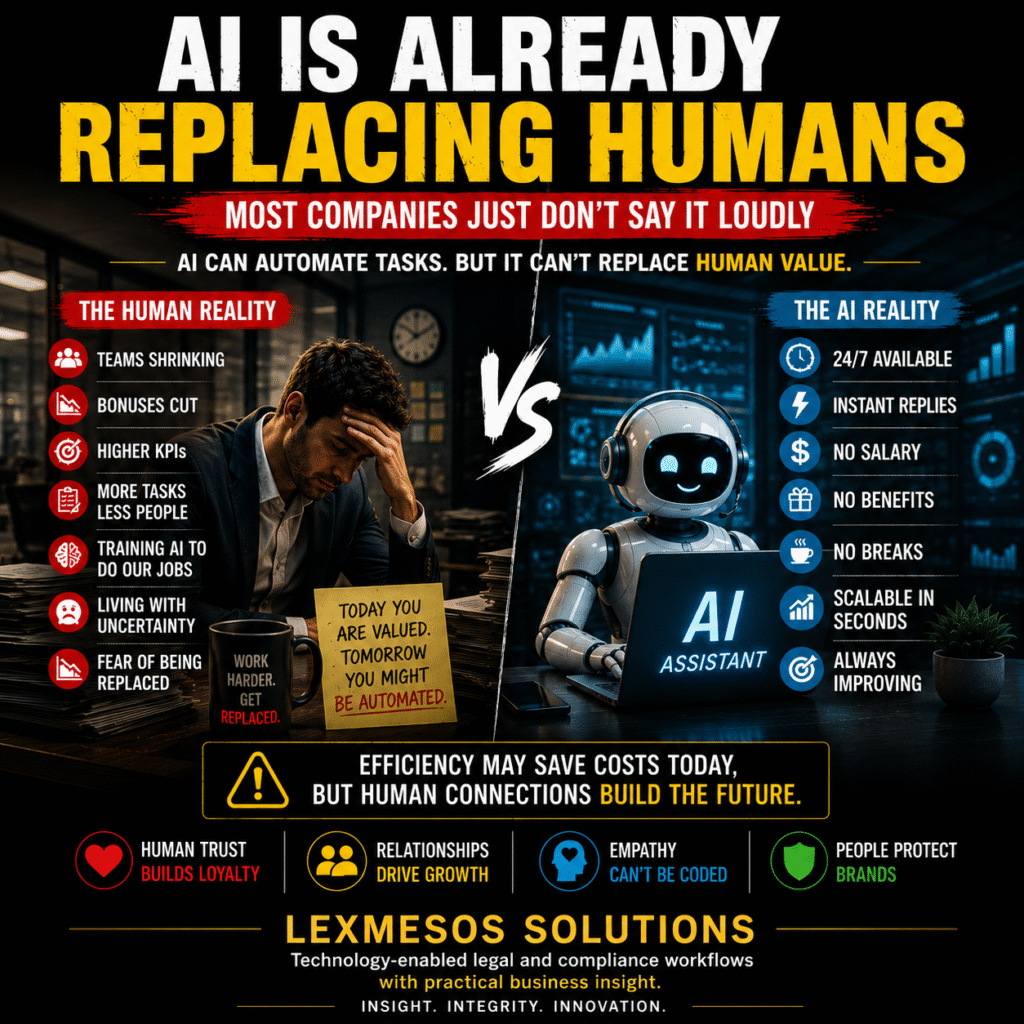
Recently, I have been hearing more conversations from people working in banking and finance sector.
Teams shrinking.
Departments quietly disappearing.
Customer support becoming increasingly automated.
Affiliate and partnership roles being reduced.
More client interactions pushed toward AI chatbots.
The explanation is usually the same:
“AI can handle it now.”
At first, it sounds like innovation.
But for many employees, it increasingly feels like something else:
replacement.
Across the global economy, companies are racing to become “AI-first”.
Microsoft, Amazon, Google and many other large corporations continue investing billions into artificial intelligence infrastructure, automation and operational restructuring. AI is no longer viewed as a future experiment. It is already becoming part of daily business operations.
And finance sectors are no exception.
In forex, fintech, brokerage, cryptomand online financial services, many companies are increasingly automating customer-facing roles. AI chatbots now handle more support tickets, onboarding queries, live chats, customer engagement and even parts of relationship management.
On paper, the numbers may look attractive.
Lower operational costs.
Smaller teams.
Faster response times.
24/7 automated interactions.
Higher efficiency.
But the reality inside many workplaces may be more complicated than the public narrative suggests.
Some employees privately describe growing pressure to compete with automation while simultaneously handling more responsibilities with fewer people.
Others talk about:
- shrinking bonus structures,
- reduced commissions,
- higher KPIs,
- smaller support teams,
- and departments being quietly phased out under the language of “AI transformation” or “digital efficiency”.
For many employees, the concern is no longer just about technology itself.
It is about whether AI is increasingly being used as a justification for cost-cutting at the human level.
Some employees also describe another uncomfortable reality:
workloads increasing while teams become smaller.
More responsibilities.
More expectations.
More pressure to maintain performance with fewer people.
In some workplaces, employees are even expected to help train internal AI systems by documenting workflows, preparing response templates, organising customer interactions or teaching chatbots how to handle client conversations.
Officially, this is often presented as:
“AI integration” or “digital transformation”.
But privately, some workers describe it very differently:
training systems that may eventually reduce the need for their own roles.
The AI conversation used to feel exciting.
For many employees now, it increasingly feels personal.
One of the biggest assumptions some companies appear to be making is this:
if AI can solve customer issues faster, then human interaction becomes less important.
But in relationship-driven industries, especially in finance and forex, that assumption may become dangerous.
A chatbot may answer questions faster.
But it usually does not notice when a frustrated client is slowly losing confidence.
It does not always recognise emotional tension, hesitation, silence or distrust.
And it certainly does not build long-term loyalty the same way experienced relationship managers, affiliate managers, account managers or customer-facing teams often do.
This is something many people outside the industry may not fully understand.
In sectors like forex and fintech, some of the most valuable business relationships are not held together purely by technology.
They are maintained through:
- trust,
- responsiveness,
- familiarity,
- reassurance during difficult moments, and
- long-term human communication.
Clients often stay because someone answered during a crisis.
Because someone followed up personally.
Because someone understood the frustration behind the message instead of replying with another automated response.
These things are difficult to automate completely.
Yet many companies increasingly view relationship-focused departments as operational costs instead of long-term revenue protection.
And this is where the hidden risk may begin.
Some companies are investing heavily into AI while quietly removing the very people responsible for maintaining client loyalty and business relationships.
The short-term numbers may improve.
But long-term relationship damage is much harder to measure until clients quietly disappear.
This does not mean AI is bad.
AI is already transforming industries in powerful ways.
It can improve workflows, automate repetitive tasks, reduce response times, support analytics, summarise information and increase operational efficiency.
Most businesses will inevitably use AI in some form moving forward.
The real issue is whether some companies are starting to confuse automation with relationship management.
Because they are not the same thing.
Not every profitable role can be measured through dashboards, response times or operational efficiency metrics.
Some jobs generate value quietly through:
- emotional intelligence,
- negotiation,
- human reassurance,
- client retention,
- trust, and
- long-term relationship management.
These are difficult to fully replace with chatbots.
Especially in industries where trust already matters heavily.
Ironically, the more companies automate, the more human trust may actually become valuable.
Because when everything starts feeling automated, clients remember the companies that still make them feel heard.
And perhaps that is the uncomfortable reality many businesses may only fully realise later:
AI can automate replies.
But human relationships still protect revenue.
Keywords; AI replacing humans, AI layoffs, AI workplace fear, fintech layoffs, forex industry AI, AI transformation, AI and jobs, customer support automation, AI chatbot customer service, relationship managers, affiliate managers, employee anxiety, workplace automation, AI restructuring, future of work, financial sector layoffs, AI operational efficiency, reduced bonuses, higher KPIs, AI integration, human interaction in business, client retention, AI cost cutting, digital transformation, workplace trends
16 May 2026