 Skip to content

Big companies are laying off employees again.
Microsoft, Amazon, Google, Meta.
And many financial and fintech companies are quietly doing the same.
Billions are now flowing into AI infrastructure, automation and “AI-first” strategies.
Departments are shrinking.
Human teams are being replaced.
Chatbots are handling more conversations than ever before.
Companies say AI can solve customer issues faster.
Maybe it can.
But there is one thing AI still struggles to detect:
the moment an important client quietly starts losing trust.
The Rush to Become “AI-First”
Across industries, companies are racing to position themselves as technology-driven businesses.
Efficiency becomes the new obsession:
- fewer employees,
- lower operational costs,
- faster response times,
- more automation,
- leaner departments.
Even relationship-focused sectors are changing.
In financial services, forex, fintech, brokerage and affiliate-driven businesses, some companies are now reducing or removing partnership and affiliate departments entirely. Chatbots and automated systems are increasingly replacing human interaction.
On paper, it looks efficient.
In reality, the risks may be larger than many companies realise.
Financial Services Were Never Just About Technology
Many financial companies now describe themselves as “tech companies”.
But clients do not always stay because of technology alone.
Especially in relationship-driven industries like forex and fintech, high-value clients often remain loyal because of:
- trust,
- responsiveness,
- familiarity,
- communication,
- reliability during problems,
- and long-term human relationships.
A chatbot may answer faster.
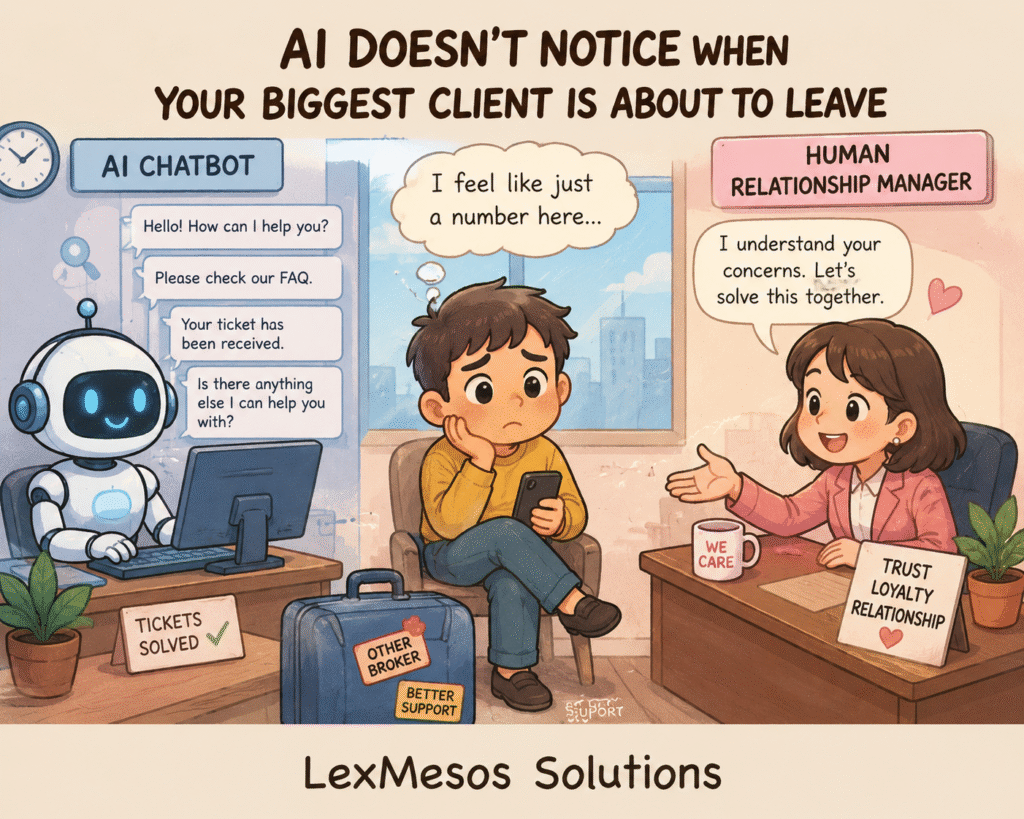
But it usually does not notice when your biggest client is preparing to leave for a competitor.
That matters more than many executives think.
The Hidden Value of Human Relationship Managers
Partnership managers, affiliate managers, account managers and customer success teams are often misunderstood internally.
Some companies see them as:
“support staff” or “cost centres”.
But in reality, experienced relationship managers often:
- retain high-value clients,
- calm tensions during disputes,
- manage reputational risks,
- prevent silent exits,
- negotiate commercial expectations,
- and maintain long-term loyalty.
Many important clients stay loyal to people, not platforms.
This is especially true in industries where trust is already fragile.
Financial services, forex, crypto and fintech sectors already face constant scrutiny involving:
- withdrawal complaints,
- platform reliability,
- regulation,
- compliance concerns,
- customer trust,
- and market volatility.
When problems happen, clients often want reassurance from a real human being- not another automated response.
AI Can Solve Tickets. It Cannot Fully Replace Trust.
AI is excellent at:
- handling repetitive queries,
- translating messages,
- generating reports,
- summarising conversations,
- automating workflows,
- and improving operational efficiency.
But retaining important clients is rarely just about solving tickets.
Sometimes the real issue is emotional:
- frustration,
- uncertainty,
- feeling ignored,
- loss of confidence,
- or lack of personal attention.
These are difficult to measure in spreadsheets.
And even harder to automate.
A senior relationship manager may notice:
- shorter replies,
- slower responses,
- changes in tone,
- reduced engagement,
- or subtle signs that a client is becoming unhappy.
AI still struggles with many of these human signals.
The Dangerous Assumption Behind Some AI Layoffs
The problem may not be AI itself.
The real danger is when companies start believing that human relationships are no longer part of the business model.
Some firms are investing heavily into AI while quietly removing the very people responsible for keeping major clients loyal.
Short-term payroll costs may decrease.
But long-term relationship damage may only become visible later:
- declining retention,
- weaker client loyalty,
- lower referrals,
- reduced trust,
- or clients quietly moving elsewhere.
And by then, rebuilding those relationships may become far more expensive.
Efficiency and Trust Are Not the Same Thing
Modern businesses absolutely need technology.
AI will continue changing financial services, legal operations, customer support and global business structures.
But not every profitable role is fully automation-friendly.
Some jobs generate value quietly:
- through trust,
- human judgment,
- emotional intelligence,
- negotiation,
- relationship-building,
- and reputation management.
These things are difficult to replace with dashboards and automated replies.
Because in high-stakes industries, clients may forgive delayed responses.
But they are far less likely to forgive feeling replaceable.
And that is something many companies may only realise after the relationship is already gone.
Keywords: AI layoffs, AI in financial services, fintech layoffs, forex industry AI, partnership managers, affiliate managers, AI chatbot customer service, client retention, human interaction in business, AI and customer trust, automation in finance, relationship management, AI replacing jobs, tech layoffs, AI and client loyalty, financial sector automation, human trust vs AI, forex affiliate management, AI-first companies, business relationship management
16 May 2026