 Skip to content

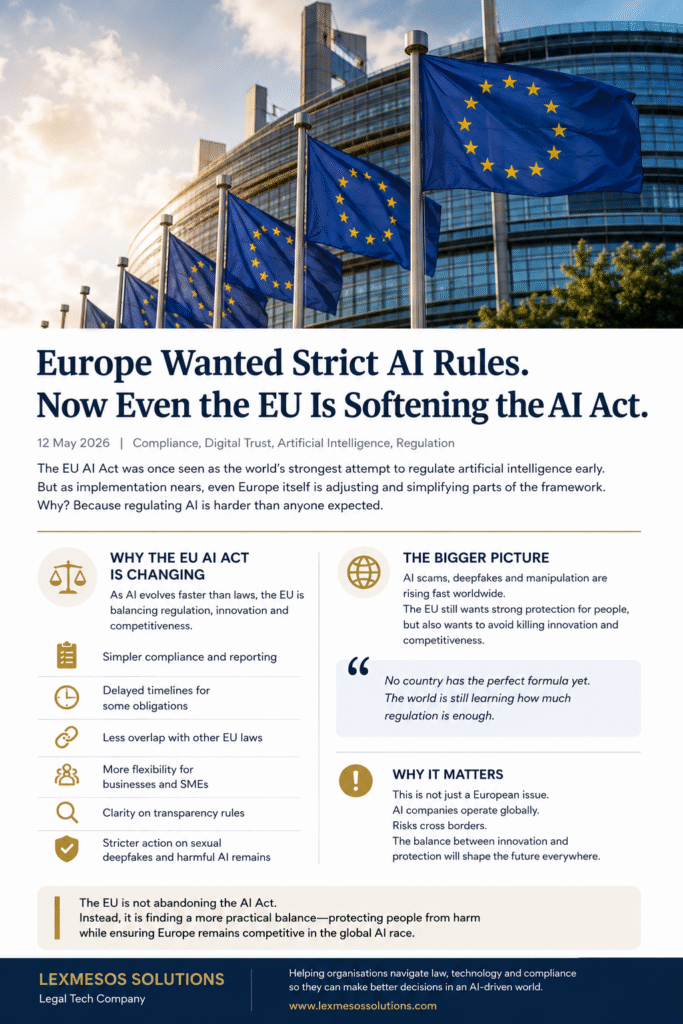
When the European Union introduced the EU AI Act, many people saw Europe as moving faster and stricter than the rest of the world on artificial intelligence regulation.
The EU talked heavily about:
- transparency
- deepfakes
- AI manipulation
- digital trust
- human rights
- platform accountability
- protection against harmful AI systems
At one point, Europe almost looked determined to regulate AI before the technology became too powerful to control.
But now, something interesting is happening.
Even the EU itself is starting to simplify and soften parts of the AI Act.
Why?
Because regulating artificial intelligence turned out to be far more complicated than many expected.
AI Is Moving Faster Than Governments
Artificial intelligence is developing at extraordinary speed.
Just within a short period, the world has already seen:
- AI voice cloning
- realistic deepfakes
- fake emergency calls
- AI-generated scams
- fake customer service agents
- manipulated political content
- AI-generated explicit images
- automated misinformation
At the same time, businesses rushed to integrate AI into:
- workplaces
- customer service
- education
- recruitment
- healthcare
- finance
- legal and compliance operations
The problem is that governments are trying to regulate something that evolves almost monthly.
And that creates a difficult balancing act.
Why Europe Originally Moved Aggressively
The EU has traditionally taken a stricter approach towards technology regulation compared to many other regions.
This can already be seen from:
- GDPR
- Digital Services Act
- Digital Markets Act
The EU’s concern has never been only about innovation.
It is also about:
- privacy
- consumer protection
- surveillance risks
- manipulation
- public trust
- algorithmic influence
- protection of vulnerable groups
European regulators feared that without early intervention, AI could create serious societal risks before legal systems were prepared.
Especially with the rise of:
- deepfake technology
- AI scams
- fake identities
- nudifier applications
- psychological manipulation
- AI-generated misinformation
And honestly, those fears are no longer hypothetical.
But Businesses Started Pushing Back
As the AI Act moved closer towards implementation, companies across Europe started raising concerns.
Many businesses argued that:
- compliance obligations were becoming too complicated
- implementation costs were too high
- legal uncertainty remained unclear
- smaller companies and startups could struggle to comply
- innovation could slow down significantly
Some feared Europe might become too restrictive while:
- the United States pushes aggressive AI development
- China accelerates strategic AI expansion
- Asia continues focusing heavily on growth and digital adoption
This created pressure on the EU to reconsider how strict and complex certain parts of the AI Act should be.
So What Is The EU Changing Now?
The EU is not abandoning the AI Act.
But it is increasingly trying to:
- simplify compliance requirements
- streamline implementation
- reduce overlapping obligations
- clarify transparency requirements
- ease burdens on companies
- provide more flexibility for businesses
At the same time, the EU still appears determined to remain strict on certain high-risk areas involving:
- sexual deepfakes
- AI manipulation
- harmful AI systems
- public transparency obligations
In other words:
Europe is now trying to find a middle ground between:
- regulation; and
- innovation.
The Real Problem Is Bigger Than Technology
This is where the discussion becomes more interesting.
The issue is no longer simply:
“Should AI exist?”
AI is already everywhere.
The deeper question is:
How much risk is society willing to tolerate before regulation becomes necessary?
Today, scams no longer need to look obviously fake.
AI can now:
- clone voices
- imitate family members
- create fake videos
- manipulate emotions
- produce realistic misinformation
And ordinary people are increasingly becoming the targets.
Across Malaysia and many Asian countries, scam-related news appears almost daily:
- impersonation scams
- fake investment schemes
- fake police calls
- Macau scams
- elderly victims losing life savings
Now imagine those scams enhanced further by artificial intelligence.
The line between real and fake becomes harder to detect.
And that directly affects public trust.
Why This Matters To Asia Too
Many people in Asia still see AI regulation as “Europe’s issue”.
But global technology rarely stays within one region.
AI companies operate internationally.
Platforms operate across borders.
Digital risks spread globally.
Even if Asian countries move more cautiously compared to Europe, AI-related harms are already becoming increasingly visible across the region.
At the same time, many Asian governments are still balancing:
- innovation
- investment
- startup growth
- competitiveness
- digital transformation goals
That is why many Asian countries currently rely more on:
- guidelines
- sector-based regulation
- existing fraud laws
- platform enforcement
instead of introducing comprehensive AI legislation immediately.
But as AI scams, deepfakes and manipulation become more realistic, pressure for stronger governance may continue growing globally.
Europe Is Not “Giving Up” On AI Regulation
Some people may wrongly assume that simplifying parts of the AI Act means the EU has failed.
That is not entirely accurate.
What is happening now actually reflects something more realistic:
governments are learning in real time.
AI regulation is not a simple “yes or no” issue.
Too little regulation may increase:
- scams
- manipulation
- digital harm
- loss of public trust
But excessive regulation may also:
- slow innovation
- increase compliance costs
- discourage startups
- reduce competitiveness
No country has fully solved this balance yet.
Not Europe.
Not Asia.
Not even the United States.
Final Thoughts
The EU AI Act was once seen as the world’s strongest attempt to regulate artificial intelligence early.
Now, even Europe itself is adjusting and softening certain parts of the framework.
Not because AI risks disappeared.
But because regulating rapidly evolving technology while maintaining innovation, business growth and public trust is far more difficult than many initially imagined.
And as AI becomes increasingly integrated into everyday life, this debate will likely affect far more than just Europe.
Because eventually, every society may need to answer the same question:
how do we benefit from artificial intelligence without losing control over the risks that come together with it?
Need support on AI governance and related compliance matters?
Keywords: EU AI Act, EU AI regulation, artificial intelligence law, AI governance, AI compliance, AI regulation Europe, AI regulation Asia, deepfakes, AI scams, digital trust, AI transparency, AI accountability, AI law changes, European Union AI Act, AI policy, AI regulation update, AI legislation, AI and innovation, AI risks, AI ethics, AI manipulation, AI governance framework, compliance and AI, AI and business regulation, AI regulation simplified, EU AI Act amendments, AI transparency obligations, AI compliance costs, AI regulation challenges, deepfake regulation, AI fraud, digital manipulation, AI legal developments, Europe AI law, AI oversight, AI technology regulation, LexMesos Solutions
LexMesos Solutions is not a law firm and do not provide legal representation or legal advice. Professional legal services are handled separately through licensed legal professionals where applicable.
13 May 2026