 Skip to content

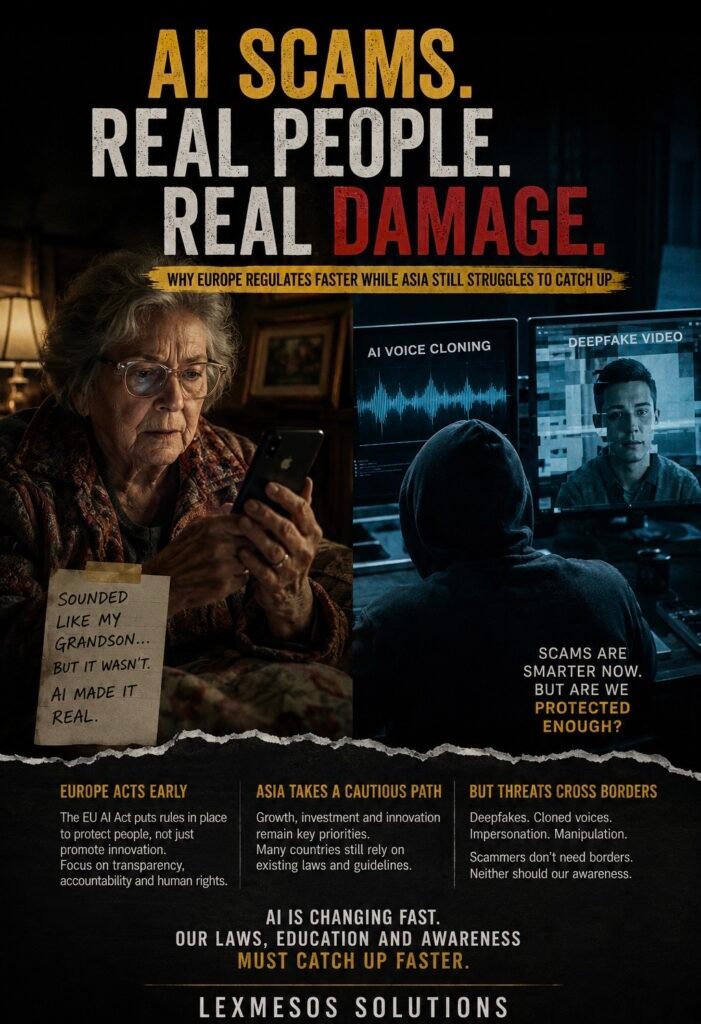
A grandmother receives a phone call.
The voice sounds familiar.
Panicked.
Urgent.
Someone she loves is supposedly in trouble.
Money is transferred within minutes.
Later, she discovers the truth:
it was a scam.
This no longer sounds like science fiction.
It sounds disturbingly normal.
Recently, public attention towards scams, online fraud and digital manipulation has grown rapidly across Asia, including Malaysia. At the same time, films like Thelma brought another uncomfortable reality into the spotlight:
modern scams are no longer targeting only the careless.
They target trust, emotion, loneliness, panic and human vulnerability.
And now artificial intelligence is making that problem even more dangerous.
AI Is Not Just About Productivity Anymore
For years, AI discussions focused on:
- automation
- efficiency
- productivity
- business innovation
- replacing repetitive work
But ordinary people are now seeing another side of AI:
- fake voices
- deepfake videos
- impersonation scams
- AI-generated fraud
- manipulated images
- fake investment promotions
- fake customer service agents
The frightening part is not just the technology itself.
It is how realistic everything has become.
A cloned voice no longer sounds robotic.
A fake video no longer looks obviously fake.
A scam message no longer contains broken grammar.
The line between reality and manipulation is becoming harder to recognise.
Why Europe Started Regulating AI Earlier
This is one reason the European Union moved aggressively with the EU AI Act and related digital regulations.
Europe has long taken a stricter approach towards:
- privacy
- consumer protection
- platform accountability
- surveillance risks
- human rights
- algorithmic influence
The European concern is simple:
What happens when technology becomes more powerful than society’s ability to control it?
The EU worries not only about business competition, but also:
- manipulation of citizens
- harmful AI systems
- misinformation
- exploitation of vulnerable groups
- psychological influence
- loss of public trust
This is why Europe introduced:
- GDPR
- Digital Services Act
- Digital Markets Act
- and now the EU AI Act
even while many other countries were still debating whether regulation was necessary.
Asia Uses AI Heavily Too- So Why The Slower Pace?
Asia is not behind in AI usage.
In fact, many Asian societies are deeply integrated with:
- digital payments
- e-commerce
- social commerce
- mobile banking
- online platforms
- AI tools
But many Asian governments are still balancing another concern:
economic growth.
Heavy regulation too early may:
- discourage investment
- slow innovation
- hurt startups
- reduce competitiveness
- affect digital transformation goals
As a result, many countries in Asia still rely more heavily on:
- existing criminal laws
- fraud laws
- platform policies
- voluntary AI guidelines
- self-regulation
instead of introducing comprehensive AI legislation immediately.
But Reality Is Changing Fast
The problem is that scams are evolving faster than public awareness.
Across Malaysia and other parts of Asia, scam-related news appears almost daily:
- fake parcel scams
- fake banking calls
- fake police officers
- cryptocurrency fraud
- impersonation scams
- romance scams
- fake investment schemes
Now imagine those same scams enhanced by AI.
A cloned voice of your child.
A realistic video of a company executive.
A fake emergency call generated within seconds.
Technology reduces the “warning signs” people used to rely on.
And elderly victims are often the most vulnerable.
The Real Issue Is No Longer Technology Alone
The deeper issue is trust.
Modern societies increasingly rely on digital systems for:
- communication
- banking
- work
- identity
- relationships
- news
- public information
Once trust becomes unstable, the social impact becomes much larger than financial loss alone.
People begin questioning:
- what is real
- who is genuine
- whether audio can be trusted
- whether videos are authentic
- whether online communication is safe
This is why AI governance is no longer just a “tech industry issue”.
It is becoming a social issue.
A human issue.
A public trust issue.
Regulation Alone Will Never Fully Solve the Problem
Even the strictest laws cannot eliminate:
- greed
- manipulation
- deception
- emotional exploitation
Technology changes quickly.
Human vulnerability remains constant.
This means AI regulation alone is not enough.
Public awareness, digital literacy and ethical responsibility may become equally important in the years ahead.
Because sometimes the biggest danger is not artificial intelligence itself.
It is how easily human trust can be exploited through it.
Final Thoughts
AI tools are already deeply integrated into modern life.
The question is no longer whether societies will use AI.
The real question is:
how prepared are societies for the risks that come together with it?
Europe chose to regulate early.
Many Asian countries are still moving more cautiously.
But as scams, deepfakes and digital manipulation become more sophisticated, pressure for stronger governance may continue growing globally.
Especially when ordinary people not just corporations are becoming the targets.
Need support on AI governance, compliance frameworks or digital risk awareness initiatives?
Keywords: AI scams, deepfake scams, AI voice cloning, AI fraud, AI regulation, EU AI Act, AI governance, AI and scams, digital fraud, cyber scams, online scams Malaysia, AI compliance, deepfake technology, scam awareness, scam prevention, artificial intelligence risks, AI misuse, AI manipulation, digital trust, AI ethics, Europe AI regulation, Asia AI regulation, Malaysia AI law, AI and human rights, scam victims, elderly scam victims, AI impersonation scams, fake voice scams, AI-generated scams, technology and society, digital safety, AI accountability, AI regulation Asia vs Europe, AI governance Malaysia, AI awareness, online fraud prevention, AI policy, digital manipulation, scam culture, AI legal issues, LexMesos Solutions
LexMesos Solutions is not a law firm and do not provide legal representation or legal advice. Professional legal services are handled separately through licensed legal professionals where applicable.
13 May 2026