 Skip to content

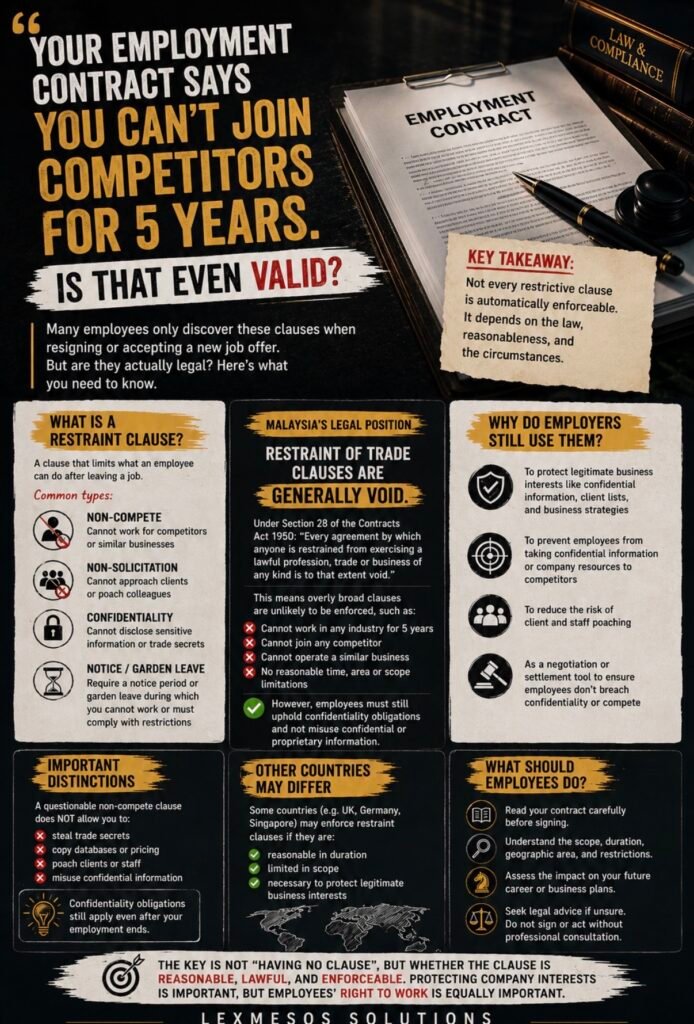
Employees today are changing jobs more frequently than before.
But many only discover a problem after resigning:
“You are prohibited from working with competitors for the next 3–5 years.”
Some employment contracts go even further:
- restrictions across entire industries
- bans on approaching former clients
- clauses preventing employees from joining similar businesses
- threats of legal action after resignation
This raises an important question:
Can an employer really stop someone from earning a living after leaving a job?
The answer depends heavily on the country, the wording of the contract, and whether the restriction is considered reasonable under the law.
What Is a “Restraint of Trade” Clause?
A restraint of trade clause is a contractual term designed to restrict what an employee can do after leaving employment.
Common examples include:
- Non-compete clauses
“You cannot work for competitors.”
- Non-solicitation clauses
“You cannot approach former business partners, clients or staffs.”
- Confidentiality obligations
“You cannot disclose internal information or trade secrets.”
Employers often argue these clauses are necessary to protect:
- confidential business information
- client relationships
- pricing structures
- internal strategies
- trade secrets
Employees, however, may view them differently:
- career restrictions
- pressure tactics
- unfair control after resignation
- barriers to earning a living
Malaysia: Are Non-Compete Clauses Valid?
Malaysia takes a relatively strict position against restraints of trade.
Under Section 28 of the Contracts Act 1950:
“Agreement in restraint of trade void
Every agreement by which anyone is restrained from exercising a lawful profession, trade, or business of any kind, is to that extent void.”
In simple terms, agreements that prevent a person from carrying on a lawful profession, trade or business are generally unenforceable.
This means broad clauses such as:
- “You cannot work in this industry for 5 years”
- “You cannot join any competitor”
- “You cannot operate a similar business”
may face serious enforceability issues in Malaysia.
But Why Do Employers Still Include These Clauses?
Because many employees:
- do not know the legal position
- fear legal threats
- avoid disputes due to costs and stress
- comply voluntarily even if the clause may be questionable
In reality, some restraint clauses are drafted very aggressively.
Especially in industries involving:
- sales and marketing
- technology
- telecommunication
- recruitment
- finance
- consulting
- legal and compliance services
Important: Employees Still Cannot Misuse Confidential Information
This is where many people misunderstand the issue.
A problematic non-compete clause does NOT automatically allow someone to:
- copy customer databases
- steal confidential pricing
- misuse trade secrets
- disclose internal documents
- divert clients unfairly
Confidentiality obligations can still remain important even after employment ends.
The legal issue often becomes:
Is the employer genuinely protecting confidential business interests, or simply trying to block competition?
UK and Europe Take a Different Approach
Unlike Malaysia, some jurisdictions may recognise restraint clauses if they are considered reasonable and proportionate.
Countries such as:
- the United Kingdom
- Germany
- Singapore (in certain situations)
may allow limited restrictions if:
- there is a legitimate business interest
- the duration is reasonable
- the scope is not excessive
- the restriction is necessary to protect the business
For example:
- a short restriction period
- limited client-related restrictions
- senior management roles
- protection of trade secrets
may sometimes be viewed differently compared to broad industry-wide bans.
The Workplace Reality
Today, many employment contracts contain lengthy clauses that employees may never properly read before signing.
Some workers only realise the impact after:
- resigning
- receiving legal warning letters
- accepting a new job offer
- starting a competing business
This creates tension between:
- business protection
and
- an individual’s right to work and earn a living
As industries become more competitive, disputes involving employment restraints may continue to grow.
Final Thoughts
Employment contracts matter.
But not every clause automatically becomes enforceable simply because it was signed.
The enforceability of restraint clauses depends on:
- local law
- reasonableness
- business justification
- scope and duration
- the surrounding circumstances
Both employers and employees should understand the legal and practical implications carefully before relying on overly broad restrictions.
Need support with employment-related documents, compliance workflows or contract governance matters?
Keywords: restraint of trade Malaysia, non compete clause Malaysia, employment contract Malaysia, can employer stop employee from working competitor, restraint of trade clause employment contract, non competition clause Malaysia, employee rights Malaysia, post employment restrictions Malaysia, employment law Malaysia non compete, restrictive covenant Malaysia, can employer stop me from joining competitor, validity of non compete clause Malaysia, restraint of trade Contracts Act 1950, Section 28 Contracts Act 1950, employee resignation legal issues Malaysia, confidentiality clause employment contract, non solicitation clause Malaysia, employment contract restrictions after resignation, legal enforceability of non compete clause, working for competitor after resignation Malaysia, Is a 5 year non compete clause valid in Malaysia, Can employers stop employees from joining competitors, Are restraint of trade clauses enforceable in Malaysia, What happens if I join competitor after resignation, Can a company sue ex employee for joining competitor, Malaysia employment contract restrictive clauses, Employee restraint of trade legal position Malaysia, Difference between non compete and confidentiality clause, Can employment contract prevent future employment, Post resignation employment restrictions Malaysia
LexMesos Solutions is not a law firm and do not provide legal representation or legal advice. Professional legal services are handled separately through licensed legal professionals where applicable.
12 May 2026