 Skip to content
Malaysia, UK and Germany Take Very Different Approaches.
Many people assume that when someone dies, their spouse or children will automatically inherit everything.
But legally, that is not always true.
If a person dies without a will, the law decides:
- who inherits,
- how much they receive,
- and sometimes who gets nothing.
This is known as:
👉 intestacy law
And different countries handle it very differently.
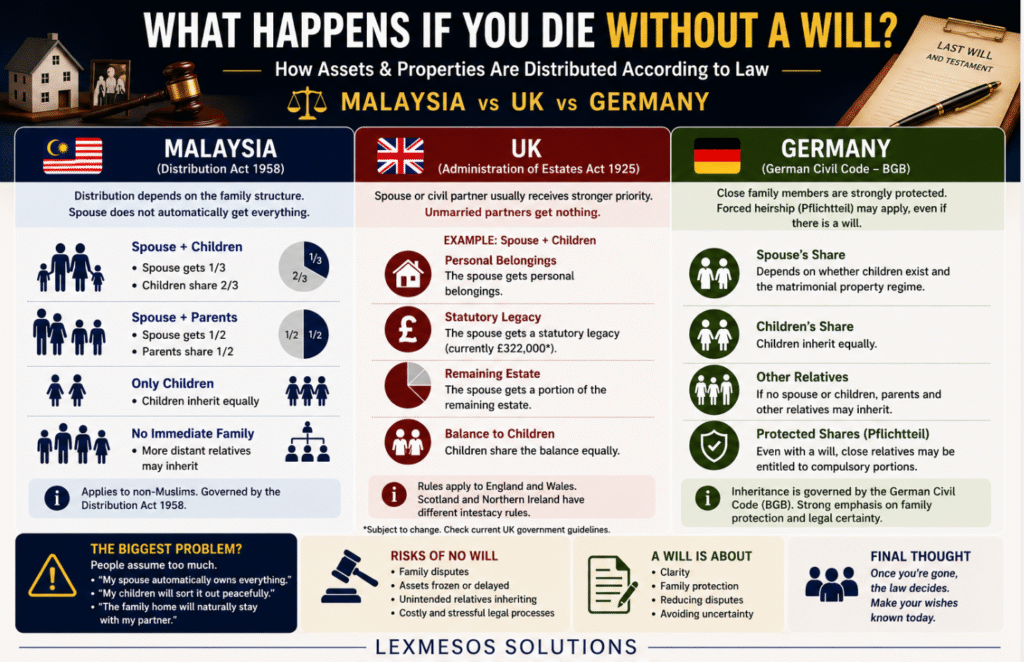
Malaysia: Distribution Depends on Family Structure
In Malaysia, if a non-Muslim dies without a will, distribution is governed mainly by the Distribution Act 1958.
The estate does not automatically go fully to the spouse.
Instead, the law follows fixed formulas depending on surviving family members.
For example:
If the deceased leaves:
- spouse + children
-spouse gets 1/3
-children share 2/3
If there is:
- spouse + parents
-spouse gets 1/2
-parents share 1/2
If only children survive:
-children inherit equally
If no immediate family exists:
-more distant relatives may inherit
This often surprises people.
Many assume:
“Everything automatically goes to my husband/wife.”
But under Malaysian law, children and parents may also legally share the estate.
The UK: Spouses Have Stronger Priority
England and Wales follow intestacy rules under the Administration of Estates Act 1925.
The surviving spouse or civil partner usually receives stronger protection compared to some other systems.
Currently, if someone dies leaving:
- spouse + children,
the spouse generally receives:
- personal belongings,
- a statutory legacy amount,
- plus part of the remaining estate.
Children share the balance.
However:
👉 unmarried partners usually receive nothing automatically under intestacy law.
This becomes a major issue for long-term couples who never legally married.
Many people only realise this after death disputes begin.
Germany: Forced Heirship and Reserved Shares
Germany takes a very structured civil law approach.
Under German inheritance law (Erbrecht), close family members are heavily protected.
Even if a will exists, certain relatives may still be legally entitled to compulsory portions (Pflichtteil).
If there is no will:
- spouses,
- children,
- and close relatives
inherit according to statutory inheritance rules under the German Civil Code (BGB).
The spouse’s share depends partly on:
- whether children exist,
- and the matrimonial property regime.
Germany strongly prioritises:
- bloodline inheritance,
- family protection,
- and legal certainty.
The Biggest Problem: People Assume Too Much
Across many countries, the biggest issue is not the law itself.
It is assumption.
People often assume:
- “my spouse automatically owns everything”
- “my children will sort it out peacefully”
- “the family house will naturally stay with my partner”
But reality can become very complicated.
Without proper planning:
- family disputes may arise,
- assets may freeze temporarily,
- unintended relatives may inherit,
- and court processes may become expensive and stressful.
A Will Is Not Only About Wealth
Many people think wills are only for the rich.
Not true.
A will is often about:
- clarity,
- family protection,
- reducing disputes,
- and avoiding uncertainty.
Because once someone passes away,
they can no longer explain what they intended.
At that point:
👉 the law speaks for them.
Final Thought
Death is emotional.
But inheritance is also legal.
And if no instructions are left behind,
different countries will apply very different rules to decide:
- who receives what,
- who controls the estate,
- and sometimes who gets left out entirely.
That is why understanding inheritance law matters far more than many people realise.
Without proper planning:
• family disputes may happen,
• assets may be delayed or frozen,
• unintended relatives may inherit.
A will is not only about wealth.
It is about protecting the people you leave behind.
At LexMesos Solutions, we also provide:
✔ Ready-made Standard Will Template
✔ Special Will Template
Keywords: will, special will, dying without a will Malaysia, intestacy law UK Germany Malaysia, inheritance law comparison, Distribution Act 1958 Malaysia, German inheritance law, UK intestacy rules
11 May 2026