 Skip to content

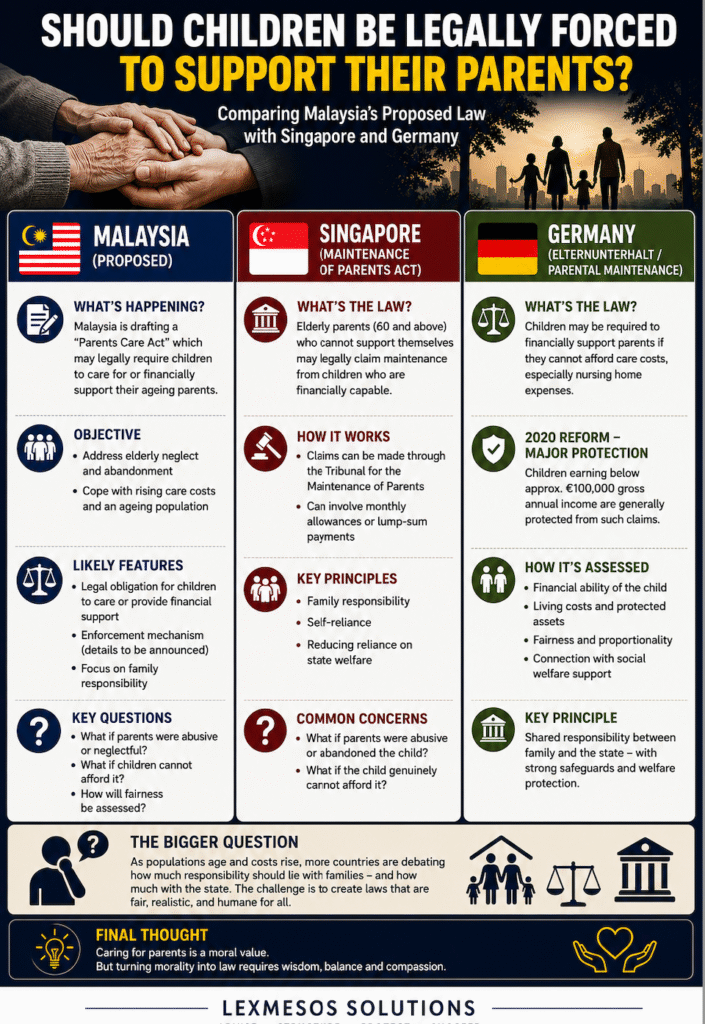
Malaysia, Singapore and Germany Take Different Approaches.
Malaysia is now considering a new law that may legally require children to care for or financially support their ageing parents.
The proposal comes as Malaysia moves towards becoming an ageing society, with growing concerns over elderly neglect, abandonment and rising care costs. Deputy Prime Minister Ahmad Zahid Hamidi recently stated that the government aims to draft a proposed “Parents Care Act” within six months. (Free Malaysia Today)
At first glance, many people may think:
“Of course children should care for their parents.”
But legally, the issue is far more complicated.
Different countries have adopted very different approaches, and the debate is not just about morality.
It is also about:
- welfare systems,
- economic pressure,
- family breakdown,
- abuse,
- ageing populations,
- and the role of the state itself.
Singapore: Parents Can Legally Claim Maintenance
Singapore is one of the best-known examples in Asia.
Under the Maintenance of Parents Act, elderly parents aged 60 and above who cannot support themselves may legally claim maintenance from children who are financially capable but refuse to provide support. (NLB)
Claims may involve:
- monthly allowances,
- lump-sum payments,
- or tribunal proceedings.
Singapore established a dedicated Tribunal for the Maintenance of Parents to handle such disputes.
The law reflects Singapore’s long-standing emphasis on:
- family responsibility,
- self-reliance,
- and reducing excessive dependence on state welfare.
However, even in Singapore, the issue remains controversial.
Critics often ask:
- What if the parents were abusive?
- What if the child was abandoned during childhood?
- What if the child genuinely cannot afford it?
These are the difficult realities many online discussions immediately raise whenever such laws are mentioned.
Germany: Yes, But With Stronger Safeguards
Germany also has legal obligations between parents and children under the German Civil Code (Bürgerliches Gesetzbuch / BGB).
This is known as:
👉 Elternunterhalt (parental maintenance).
If elderly parents cannot afford nursing home or care costs, adult children may potentially be required to contribute financially. (BMJV)
But Germany introduced major reforms in 2020.
Under the new rules:
👉 Children earning below approximately €100,000 annual gross income are generally protected from parental maintenance claims. (Verbraucherzentrale.de)
The German government explained that the reform was designed to reduce pressure on ordinary families and provide relief to relatives caring for family members. (Bundesregierung)
In practice, Germany’s system is usually more connected to:
- social welfare structures,
- proportionality,
- financial ability,
- and legal safeguards.
The state does not simply say:
“All children must pay.”
Instead, courts and authorities often assess:
- income level,
- actual affordability,
- protected assets,
- and fairness.
This reflects a broader European approach where elderly care is seen as a shared issue between:
- family responsibility,
- and state welfare responsibility.
Malaysia: A New Debate Begins
Malaysia currently does not have a direct nationwide law similar to Singapore’s Maintenance of Parents Act.
But that may soon change.
The proposed legislation appears aimed at addressing:
- abandonment of elderly parents,
- rising care costs,
- and social pressure from an ageing population. (Free Malaysia Today)
Supporters argue:
- children should not abandon ageing parents,
- family responsibility is part of Asian values,
- and society cannot rely entirely on public welfare systems.
But critics immediately raise difficult questions:
What if:
- parents were abusive?
- children were neglected?
- family relationships broke down long ago?
- adult children themselves struggle financially?
Because once morality becomes law,
the issue becomes far more complicated.
The Bigger Question Nobody Wants to Ask
These laws reveal something deeper happening globally.
Many countries are facing:
- ageing populations,
- lower birth rates,
- rising healthcare costs,
- and pressure on pension and welfare systems.
As governments struggle with long-term elderly care costs, responsibility slowly shifts back towards families.
That is why this debate is becoming more common not only in Asia, but also in Europe.
Final Thought
Morally, many people believe children should care for their parents.
But legally forcing family responsibility is another matter entirely.
Because not every family story is the same.
The real challenge for lawmakers is not creating emotional slogans, but creating laws that are:
- fair,
- proportionate,
- financially realistic,
- and humane.
And that is where the real legal debate begins.
Keywords: Malaysia Parents Care Act, Singapore Maintenance of Parents Act, Germany parental maintenance law, elderly care law Malaysia, children support parents law, Elternunterhalt Germany
8 May 2026