 Skip to content
Imagine opening your favourite social media app and finally knowing who paid for an advertisement, why you were targeted and where the advertisement leads.
That is exactly what the European Union is trying to achieve.
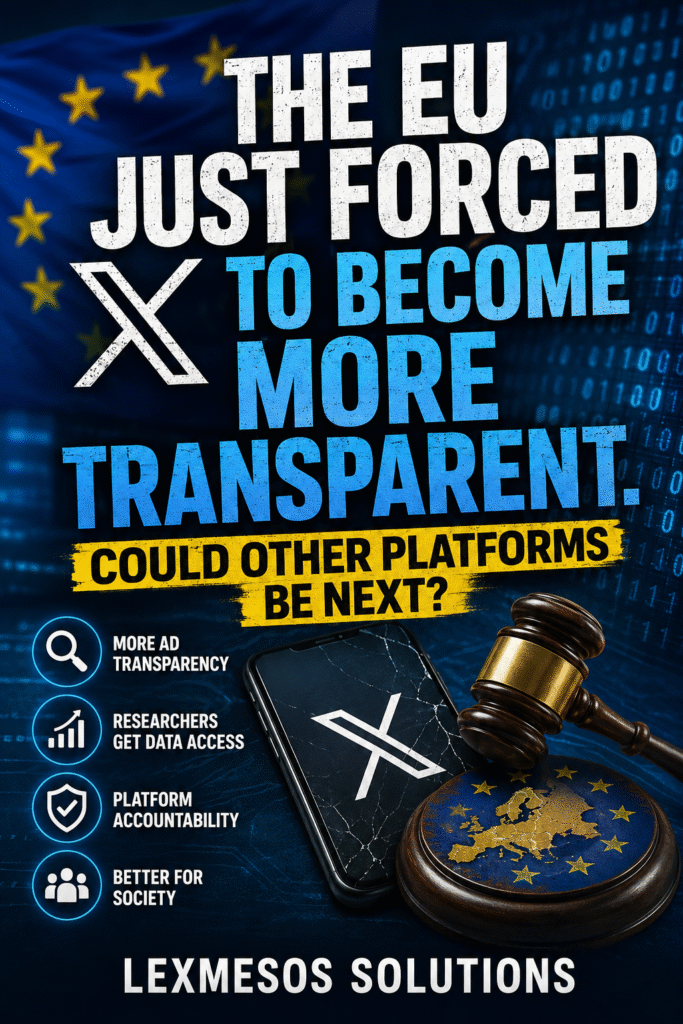
The European Commission has accepted X’s (formerly Twitter) action plan to comply with the Digital Services Act (DSA) after previously finding that the platform had breached the law and imposing a €120 million fine in December 2025. X now has 6 months to implement a series of transparency measures, undergo an independent external audit and remain under enhanced regulatory supervision.
This is not just another headline about Elon Musk.
It is a glimpse into the future of how governments expect major online platforms to operate.
What Happened?
The European Commission concluded that X needed to improve the way it handles advertising transparency and access to public platform data for eligible researchers.
Instead of continuing a lengthy enforcement process, the Commission accepted X’s action plan, provided the company follows through with its commitments within the next six months.
In simple terms, X has agreed to make its platform more transparent.
So, What Will Change?
Under the agreed plan, X has committed to:
- Improve its advertising library so advertisements are easier to search.
- Show more information about advertisements.
- Display search results directly instead of requiring spreadsheet downloads.
- Make the system much faster.
- Allow eligible researchers to access public data more effectively and free of charge.
- Update its terms so eligible researchers are not prevented from collecting publicly available information where permitted.
- Undergo an independent external audit after implementing these changes.
For most users, these changes may not be immediately noticeable.
For researchers, regulators and society, they could make it much easier to understand how online platforms operate.
Why Should Ordinary Businesses Care?
Many business owners may think:
“We don’t own X, so this doesn’t affect us.”
Not directly.
But it does reveal an important global trend.
Governments are paying closer attention to how digital platforms operate, how online advertisements are presented and how technology companies handle transparency and accountability.
The message is becoming increasingly clear:
If your business operates online, transparency is no longer just good practice, it is becoming an expectation.
This Isn’t Just About Elon Musk
The Digital Services Act does not exist to punish one company.
Its broader goal is to create a safer and more transparent online environment across Europe.
Whether people are buying products, reading news or interacting with AI-generated content, regulators want users to better understand:
- Why they are seeing certain advertisements.
- Who is paying for them.
- How platforms manage potential risks.
- Whether researchers can independently study the platform’s impact on society.
Could Other Platforms Be Next?
Very likely.
The Digital Services Act applies to other designated Very Large Online Platforms and search engines operating in the European Union.
That means X is not the only platform expected to meet higher standards of transparency and accountability. The direction of travel is clear: Europe is steadily raising expectations for how major online services should operate.
The Bigger Picture
Over the past few years, the European Union has introduced major digital laws covering:
- Personal data
- Artificial intelligence
- Online platforms
- Digital markets
- Cybersecurity
Rather than reacting after problems arise, Europe is increasingly setting rules before technology creates bigger risks.
Whether other parts of the world adopt similar approaches remains to be seen.
Final Thoughts
The biggest takeaway from this development is not that X has 6 months to comply.
It is that digital transparency is becoming a core part of doing business online.
Consumers want greater trust.
Researchers want better access.
Regulators want greater accountability.
Businesses that understand this shift early are likely to be better prepared for the future than those waiting until new rules arrive at their doorstep.
Need Help Preparing for the Next Wave of Digital Regulations?
Whether your organisation is adopting AI, developing internal governance policies or looking to strengthen digital compliance, LexMesos Solutions provides practical support to help businesses prepare for an evolving regulatory landscape.
Further Reading:
- Reuters: EU accepts action plan by Elon Musk’s X to become more transparent
- European Commission: Commission accepts X’s action plan to comply with the Digital Services Act
Keywords: EU Digital Services Act, Digital Services Act, DSA, X transparency, Elon Musk X, European Commission, online advertising transparency, digital compliance, social media regulation, platform accountability, researchers access to data, EU technology law, online platform governance, digital governance, AI governance, business compliance, advertising repository, online transparency, EU digital regulation
17 July 2026