 Skip to content
Imagine buying a new Android phone.
Instead of Google deciding which AI assistant works best with your device, you could simply choose the one you prefer.
Whether it’s ChatGPT, Gemini, Claude, Perplexity, or another AI assistant in the future, the decision may increasingly belong to you, not Google.
That is exactly what the European Union is trying to achieve.
The European Commission has issued binding measures requiring Google to make Android more open to competing AI assistants and to share certain Google Search data with rival search providers under strict privacy safeguards. While these rules apply in the European Union, their impact could influence how Android devices evolve worldwide.
What’s Happening?
For years, Google’s Android ecosystem has naturally favoured Google’s own services.
If you use an Android phone, you’ve probably noticed that Google Search, Google Assistant, and now Gemini are deeply integrated into the operating system.
The European Commission believes users should have more choice, while smaller technology companies should have a fair opportunity to compete.
The latest measures aim to make that happen.
So, What Will Change?
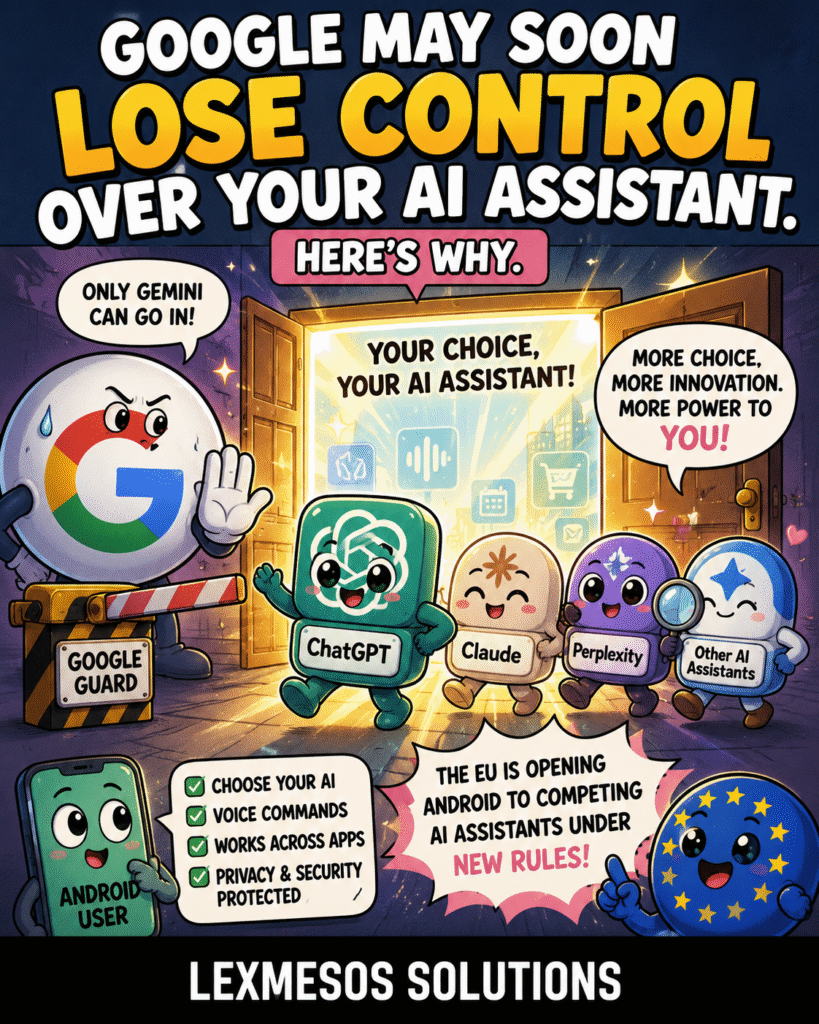
The new requirements mean Google will need to make Android more open for competing AI assistants.
In the future, Android users could be able to:
- Choose their preferred AI assistant instead of relying mainly on Google’s own service.
- Activate another AI assistant using voice commands.
- Allow alternative AI assistants to interact with apps on the phone.
- Enjoy more competition without compromising privacy or device security.
In simple terms, your Android phone may no longer be centred around just one AI ecosystem.
What About Google Search?
The changes go beyond AI assistants.
Google will also be required to share certain search data with competing search engines under privacy protections.
Why?
Because Google uses enormous amounts of search information to improve its own services.
The European Commission believes that giving competitors access to eligible data can help create a fairer marketplace and encourage innovation.
The goal is not to weaken Google.
The goal is to make it easier for other companies to compete.
Why Should You Care?
Many people think this only affects Google.
In reality, it could affect almost every Android user.
Imagine asking:
“Hey ChatGPT, book my appointment.”
instead of “Hey Google.”
Or using your preferred AI assistant to help write emails, summarise documents, search the web or manage your daily tasks directly from your phone.
That level of choice is exactly what the European Commission hopes to encourage.
Is This Bad News for Google?
Not necessarily.
Google will still be free to develop Gemini and improve Android.
However, it may no longer be able to keep the same level of exclusive control over important Android features if those features can also benefit competing AI assistants.
Google has expressed concerns that opening Android too widely could create privacy and security risks or reduce the overall user experience.
The European Commission, on the other hand, says the new measures include safeguards to protect users while increasing competition.
Could This Affect Countries Outside Europe?
Possibly.
Technology companies rarely build completely different versions of their products for every country.
When Europe introduces major digital rules, global technology companies often make broader product changes because maintaining one global system is usually more practical than maintaining many different versions.
That does not mean these exact changes will automatically apply everywhere, but decisions made in Europe often influence technology used around the world.
What Does This Mean for AI?
This is about much more than Android.
It shows that the next stage of AI competition may not be about which AI is the smartest.
Instead, it may be about which AI people are free to choose.
As AI becomes part of our phones, computers and everyday lives, user choice is becoming just as important as technological innovation.
Final Thoughts
For years, people have accepted the default apps that came with their phones.
The European Union is now asking a different question:
Should technology companies decide your default AI assistant, or should you?
Whether you support or disagree with these new rules, one thing is becoming clear:
The future of AI is no longer just about building better technology.
It is also about giving people more freedom to choose the technology they want to use.
Need Help Keeping Up with AI and Digital Regulations?
AI is changing rapidly, and so are the rules that shape it.
At LexMesos Solutions, we help businesses understand emerging AI governance, digital regulations and compliance developments through practical guidance, policy support and business-focused solutions.
Further Reading
- Reuters: https://www.reuters.com/world/google-required-open-up-ai-search-engine-rivals-under-eu-mandated-changes-2026-07-16/
- EU Perspectives: https://euperspectives.eu/2026/07/google-android-phones-must-welcome-competing-ai/
Keywords: Google Android AI assistant, ChatGPT on Android, Google Gemini, AI interoperability, Android AI choice, Google Search data, European Union AI rules, Digital Markets Act, AI competition, Google Android regulation, AI governance, Android ecosystem, ChatGPT vs Gemini, AI compliance, digital regulation, technology competition
17 July 2026