 Skip to content
You order a cheap toy online.
It arrives at your door.
It looks fine.
But what if it does not meet basic safety standards?
Or you buy a branded product at an unbelievable price, only to discover later that it is counterfeit?
For years, one of the biggest questions surrounding online marketplaces has been simple:
Who is responsible when illegal, unsafe or counterfeit products are sold through a massive online platform?
On 20 July 2026, the European Commission gave a very expensive answer.
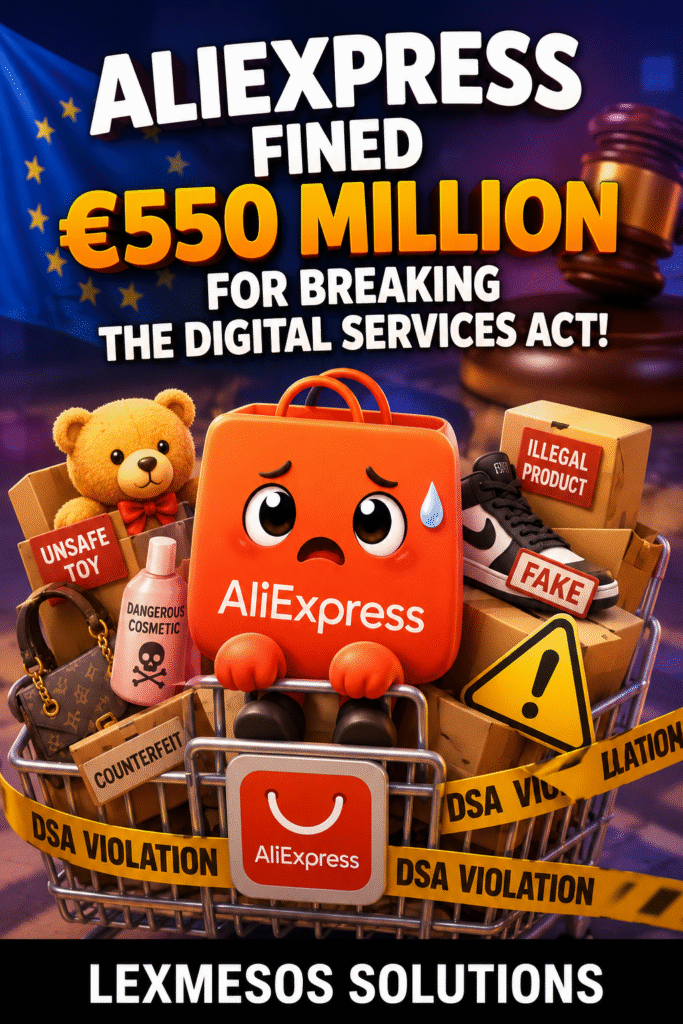
AliExpress was fined €550 million for breaching the EU’s Digital Services Act (DSA) obligations relating to the assessment and reduction of risks involving illegal, unsafe and counterfeit products on its platform. The Commission also ordered the platform to take action.
This is not just a story about AliExpress.
It sends a much bigger message to the global e-commerce industry:
Being a platform does not mean you can simply look the other way.
What Exactly Did AliExpress Do Wrong?
The issue was not simply that an illegal product appeared somewhere on the platform.
With millions of products and sellers, no marketplace can realistically promise that nothing problematic will ever appear.
The bigger issue was how the platform identified and managed those risks.
According to the European Commission, AliExpress failed to properly assess and reduce the risks of illegal, unsafe and counterfeit products being distributed through its services.
Reuters reported that regulators identified problems involving the platform’s risk assessments, staffing, systems for detecting and removing illegal products, seller penalties, and measures intended to prevent counterfeit goods. Regulators also raised concerns about how recommender and advertising systems could contribute to the spread of illegal products.
In simple terms:
The EU’s concern was not only about what was being sold.
It was also about whether the platform had built effective systems to prevent problems from happening repeatedly.
From Counterfeit Clothes to Dangerous Cosmetics
When people hear the words “counterfeit products”, they may immediately think about fake designer handbags, watches or clothing.
But the risks can be much more serious.
The European Commission specifically referred to counterfeit clothing, unsafe toys and dangerous cosmetics when discussing harmful and illegal products sold online.
A fake handbag may disappoint a buyer.
An unsafe children’s toy or dangerous cosmetic product could cause physical harm.
That is why online marketplace compliance is becoming more than an intellectual property issue.
It is also becoming a consumer safety issue.
Why €550 Million?
The size of the fine immediately attracted attention.
According to Reuters, the €550 million penalty is the largest DSA-related fine imposed by the Commission to date, exceeding the €200 million penalty previously imposed on Temu and the €120 million fine imposed on X.
AliExpress has disputed the decision, describing the fine as disproportionate and saying that it had made significant improvements to its risk-management framework. The company said it was reviewing the decision and considering its options.
So the story may not end with the fine.
But regardless of what happens next, the message from European regulators is becoming increasingly difficult for major online platforms to ignore.
The DSA Is Not Just About Social Media
Many people associate the Digital Services Act with companies such as X, Facebook or TikTok.
They think about:
- misinformation;
- online advertising;
- content moderation;
- algorithmic transparency;
- access to platform data.
But the DSA also has major implications for online marketplaces.
The AliExpress decision shows how the same regulatory framework can reach very different parts of the digital economy.
For a social media platform, the concern might involve illegal content or advertising transparency.
For an online marketplace, the concern may involve illegal or unsafe products.
Different platforms.
Different risks.
But the underlying expectation is similar:
Large digital platforms are increasingly expected to understand the risks created by their services and take meaningful steps to manage them.
Could Other Online Marketplaces Be Next?
This is perhaps the biggest question.
AliExpress is not the only international marketplace selling products to European consumers.
Global e-commerce platforms operate at enormous scale, with millions of listings appearing, disappearing and changing constantly.
The challenge is enormous.
But regulators are increasingly making it clear that scale itself is not an excuse for weak controls.
The Commission’s position is that risks must be identified and addressed systematically so consumers can shop safely online.
That means other large marketplaces operating in Europe will undoubtedly be watching this case closely.
The question for platforms is no longer simply: “Did we remove the illegal product after someone reported it?”
The bigger questions may be:
“Did we understand the risk?”
“Could sellers easily bypass our controls?”
“Did we have enough people and systems to manage it?”
“Did the same illegal products keep appearing again?”
“Did our recommendation or advertising systems make the problem worse?”
Those are much harder questions.
Technology Alone May Not Be Enough
Online marketplaces often rely heavily on automated systems to detect suspicious products.
AI can help.
Algorithms can help.
Automated moderation can help.
But technology is only as effective as the system built around it.
If sellers can easily bypass controls by changing product categories, descriptions or listings, the compliance system may look impressive on paper but fail in practice.
This is an important lesson for businesses far beyond e-commerce.
Compliance is not about having a policy or system.
It is about whether that policy or system actually works.
What Does This Mean for Businesses Selling Online?
Most small businesses will never face a €550 million fine.
But the broader lesson still matters.
If your company sells products through online marketplaces, you should understand:
- the platform’s seller rules;
- product safety requirements;
- intellectual property restrictions;
- advertising requirements;
- product labelling obligations;
- consumer protection rules.
Platforms themselves may also become stricter with sellers as regulators increase pressure on marketplace operators.
That could mean:
- stronger seller verification;
- more documentation requirements;
- faster removal of suspicious listings;
- stricter penalties for repeat violations;
- more product authenticity checks.
For legitimate businesses, stronger enforcement could ultimately be positive.
Counterfeit sellers do not only harm consumers.
They also compete unfairly with businesses that spend money complying with safety standards, intellectual property rules and consumer protection requirements.
The Bigger Picture: The EU Is Changing How Platforms Are Governed
In July 2026 alone, several major EU digital regulatory developments have highlighted how actively Europe is enforcing its digital rules.
The Commission accepted corrective measures from X relating to DSA transparency obligations.
It issued binding specifications concerning Google and AI interoperability on Android under the Digital Markets Act.
And now AliExpress has received a €550 million DSA fine over risks involving illegal, unsafe and counterfeit products.
These cases involve very different businesses.
Social media.
Search.
AI assistants.
E-commerce.
Yet they point towards the same broader trend:
Digital platforms operating at enormous scale are facing greater responsibility for how their systems affect users, businesses and society.
Final Thoughts
The AliExpress fine is about more than counterfeit products.
It raises a fundamental question about the future of online platforms:
How much responsibility should a platform carry for what happens within its ecosystem?
For years, digital businesses grew faster than many regulatory systems could respond.
That era may be changing.
The EU is increasingly expecting major platforms not only to react when something goes wrong, but to identify risks before they become widespread and demonstrate that their safeguards actually work.
AliExpress may be the headline today.
But every major online marketplace operating in Europe should be paying attention.
Because after a €550 million fine, the message is difficult to miss:
Compliance is no longer just about having rules. It is about proving that those rules work.
Build Better Digital Governance
As digital regulations continue to evolve, organisations need more than policies on paper. They need governance frameworks, practical procedures and documentation that work in the real world.
LexMesos Solutions helps businesses develop governance frameworks, AI-powered documentation, compliance policies and practical risk management solutions to prepare for today’s digital regulatory environment
Keywords: AliExpress fine, AliExpress €550 million fine, Digital Services Act, DSA compliance, EU digital regulation, online marketplace compliance, counterfeit products, illegal products online, unsafe products, e-commerce regulation, platform responsibility, consumer protection, product safety, digital compliance, risk assessment, online platform governance, corporate compliance, LexMesos Solutions.
Sources:
- European Commission- AliExpress DSA decision
- Reuters- AliExpress hit with €550 million EU fine
- Reuters- AliExpress response to the fine
21 July 2026