 Skip to content

Child Sexual Abuse Is Rising. But Are We Thinking Enough About What Happens to the Child?
A teacher is arrested.
A celebrity is convicted.
A trusted adult is accused.
A court announces a prison sentence.
People discuss whether the punishment is too harsh or too lenient. The story circulates for a few days. Then another headline replaces it.
But what happens to the child?
For an offender, a criminal sentence has a beginning and an end.
For a child who has experienced sexual abuse, there may be no comparable date on which everything simply ends.
The criminal proceedings may finish. The offender may eventually leave prison. Society may move on.
The child still has to grow up.
And perhaps this is the question we do not ask often enough:
We ask how many years the offender received. How many years will the child live with what the offender did?
Germany’s Latest Figures Should Concern Parents Everywhere
In July 2026, Germany’s Federal Criminal Police Office reported more than 17,000 cases of sexual violence against children in the previous year. DW described the number of recorded cases as remaining alarmingly high.
But even recorded crime statistics do not necessarily reveal the true scale of the problem.
Germany’s Independent Federal Commissioner Against Child Sexual Abuse explains that police statistics capture reported cases. Its earlier figures showed 15,520 cases of child sexual abuse in 2022, alongside 42,075 cases concerning the distribution, acquisition, possession or production of child sexual-abuse imagery. It also cautions that many offences remain hidden and that reported cases had been rising for several years.
There is another fact parents should notice.
German data indicates that girls account for approximately two-thirds of those affected and boys around one-third.
Boys are victims too.
And that matters because stereotypes about who can be sexually abused can make it even harder for some children to tell an adult what happened.
Sometimes the Person a Child Is Told to Trust Is the Person Accused
Parents naturally warn children about strangers.
Don’t follow a stranger.
Don’t get into a stranger’s car.
Don’t talk to suspicious people online.
Those warnings matter.
But child sexual abuse presents a much more difficult problem because the danger is not necessarily a stranger.
It may involve someone the child knows.
A teacher.
A tutor.
A coach.
A counsellor.
A religious instructor.
A relative.
Or another adult whom the child has specifically been taught to respect.
Malaysia has had disturbing cases illustrating exactly this problem.
In February 2025, a counselling teacher in Seremban pleaded not guilty to charges involving alleged physical sexual assaults against two 11-year-old boys inside a primary school’s counselling room. He also faced charges concerning possession of child sexual-abuse material. Those allegations must, of course, be distinguished from a conviction.
More recently, in June 2026, another Malaysian teacher was charged with two counts of physically sexually assaulting a 13-year-old male student. He pleaded not guilty.
These cases do not establish that schools or teachers generally are dangerous.
They establish something much more important:
A position of trust should never make an adult immune from scrutiny.
The Taiwan Case Raises Another Difficult Question
In Taiwan, entertainer Huang Tzu-chiao (黃子佼) was convicted over his possession of sexual images involving children and adolescents.
According to the Taipei District Court, investigators found 2,259 sexual images involving 35 children and adolescents.
The court sentenced him to eight months’ imprisonment and imposed a fine.
In explaining its decision, the court considered, among other matters, the quantity of material, his conduct, personal circumstances and lack of a previous criminal conviction.
It is important not to oversimplify this case.
Possessing child sexual-abuse material is legally different from producing it, distributing it or physically sexually abusing a child. Different offences carry different sentencing frameworks.
But cases like this understandably create a broader societal question.
When thousands of images involving dozens of children are involved, how should criminal law measure the harm?
Eight months?
Eight years?
Twenty years?
There is no sentence capable of deleting what happened to the children depicted in those images.
And there is another uncomfortable reality about such material.
Someone had to want it.
Someone had to acquire it.
Someone had to store it.
Demand for abusive material is itself part of an ecosystem in which children are exploited.
Epstein Showed What Happens When Power Enters the Equation
The Jeffrey Epstein case remains one of the clearest examples of why the public questions whether wealth, influence and access can affect the way sexual exploitation cases are handled.
Under a controversial non-prosecution agreement, Epstein agreed to plead guilty to Florida state charges and serve 18 months in county jail. The arrangement meant that the U.S. Attorney’s Office would not bring federal charges arising from its investigation into his conduct between 2001 and 2007. DOJ records later described the agreement as unusual in its breadth, leniency and secrecy.
Epstein was also permitted extensive work release while serving his sentence. Internal DOJ records show that federal prosecutors themselves raised concerns about whether this was consistent with the incarceration contemplated by the agreement.
The Justice Department’s later review concluded that the victims were not treated with the forthrightness and sensitivity expected by the Department and that then-U.S. Attorney Alexander Acosta exercised poor judgment in resolving the federal investigation through the non-prosecution agreement.
Epstein was federally charged again in 2019 with sex trafficking of minors, but died before those charges went to trial. He was therefore never convicted or sentenced on the 2019 federal charges.
The history leaves a much bigger question:
When an offender has money, influence, status or access to powerful people, does the justice system protect vulnerable children strongly enough?
Malaysia Is Strengthening Its Law
Malaysia should not simply be portrayed as a country doing nothing about the problem.
In fact, there has just been an important reform.
On 30 June 2026, Parliament passed amendments to the Sexual Offences Against Children Act, extending Malaysian criminal jurisdiction to certain child sexual offences committed abroad by permanent residents and people habitually residing in Malaysia.
The change recognises a modern reality: child sexual exploitation can cross countries, devices and jurisdictions.
But legislation on paper is only one part of child protection.
As lawyers and child-rights advocates quoted by SCMP pointed out, cross-border prosecution still depends upon obtaining evidence, securing cooperation from foreign governments and supporting child victims through complicated proceedings.
In other words:
A stronger law matters. Enforcement matters too. And what happens to the child afterwards matters just as much.
Malaysia Has Been Warned About the Online Problem for Years
ECPAT International has previously highlighted Malaysia’s vulnerability to online child sexual exploitation.
Malaysia’s Sexual Offences Against Children Act 2017 was an important development because it addressed conduct including online grooming and child sexual abuse/exploitation material.
But ECPAT also highlighted serious implementation and enforcement concerns.
Among the historical figures it cited was a Royal Malaysia Police finding that at least 17,338 IP addresses downloaded or uploaded child sexual-abuse material in 2018.
More than 400 Malaysian websites hosting such material had reportedly been blocked between 2015 and 2018 following complaints.
Those are older figures and should not be presented as Malaysia’s current 2026 situation.
But they demonstrate something important:
The online dimension of child sexual exploitation did not suddenly appear with artificial intelligence.
It has been developing for years.
Now Technology Makes the Problem Even Harder
Previously, parents might have imagined child sexual abuse primarily as physical contact.
The digital world changed that.
A photograph can be copied.
A video can be downloaded.
A file can be stored thousands of kilometres away.
Something removed from one website can appear somewhere else.
And artificial intelligence adds another layer.
Germany is already debating how existing sexual-offence laws should respond to AI-generated sexual deepfakes and other forms of technology-enabled sexual abuse.
Germany has also reported continuing problems with children’s publicly accessible images being copied, edited, manipulated or placed into completely different contexts online.
That brings us to something many parents may not immediately connect with child sexual abuse:
the ordinary photographs of their children that they upload publicly.
“But It’s Just a Cute Photo of My Child”
A birthday.
The first day of school.
A swimming pool.
A family holiday.
A funny video.
There is nothing inherently wrong with a parent wanting to preserve and share happy memories.
And posting a photograph does not make a parent responsible for someone else’s criminal behaviour.
But there is an uncomfortable technological reality.
Once an image is publicly available online, control over that image becomes much harder.
It may be copied without permission.
Saved.
Reposted.
Manipulated.
Or potentially incorporated into AI-generated imagery.
This is why the question is no longer simply:
“Is this photograph embarrassing for my child?”
It is also:
“Do I know where this photograph could eventually go?”
We explored that issue separately in our article about children’s photographs and consent.
And perhaps parents who dismissed that conversation several years ago should reconsider it in the age of generative AI.
“Don’t Talk About Sex” Does Not Necessarily Protect a Child
There is another issue that technology cannot solve.
Silence.
Some families understandably want to preserve childhood innocence.
But protecting innocence does not require keeping children ignorant about boundaries.
A child needs age-appropriate ways of understanding:
An adult should not ask them to keep certain touching secret.
An adult should not ask them for intimate photographs.
A teacher does not automatically have the right to touch them because he or she is a teacher.
A coach is not entitled to sexualise them.
Someone offering gifts, attention or affection online may not necessarily have innocent intentions.
And most importantly:
A child needs to know that telling a trusted adult will not get the child into trouble.
If conversations involving bodies and sexual boundaries are so shameful that a child believes they cannot even say the words at home, we have to ask ourselves:
Who benefits from that silence: the child or the abuser?
Listen When a Child Suddenly Says “I Don’t Want to Go”
Children do not necessarily disclose sexual abuse by walking into the living room and announcing exactly what happened.
Sometimes something changes first.
A child suddenly refuses to attend tuition.
They become frightened of one particular adult.
They do not want to attend training anymore.
Their behaviour changes after returning from somewhere.
They become unusually withdrawn.
They suddenly become distressed about going to school.
None of those things proves sexual abuse.
There can be many explanations.
But they deserve attention.
A parent does not need to immediately interrogate the child or make accusations.
The first responsibility is much simpler:
Listen.
And Please Remember the Boys
One of the most dangerous assumptions society can make is that sexual abuse is primarily something that happens to girls.
German figures indicate that roughly one-third of those affected are boys.
Malaysian criminal cases and prosecutions involving male pupils demonstrate the same reality.
A boy may be frightened.
He may be embarrassed.
He may believe people will laugh at him.
He may fear questions about his masculinity or sexuality.
And society sometimes makes that problem worse by treating sexual contact involving boys as a joke rather than recognising that a child cannot be expected to carry an adult’s sexual behaviour.
A son needs protection just as much as a daughter does.
Is Harsher Punishment the Answer?
Partly.
Serious crimes require serious consequences.
Strong sentencing can punish offenders, incapacitate dangerous individuals and communicate society’s condemnation of sexual exploitation of children.
But Malaysia demonstrates why the issue cannot be reduced to:
“Just increase the prison sentence.”
Malaysia already provides severe penalties for various sexual offences against children and is now expanding the jurisdictional reach of its legislation.
Germany has extensive child-protection and criminal laws.
Taiwan criminalises child sexual exploitation material.
The United States has powerful federal criminal legislation.
And yet abuse still happens.
So punishment is necessary.
But punishment happens after something has already happened to a child.
A genuinely child-centred system must ask what could have prevented it.
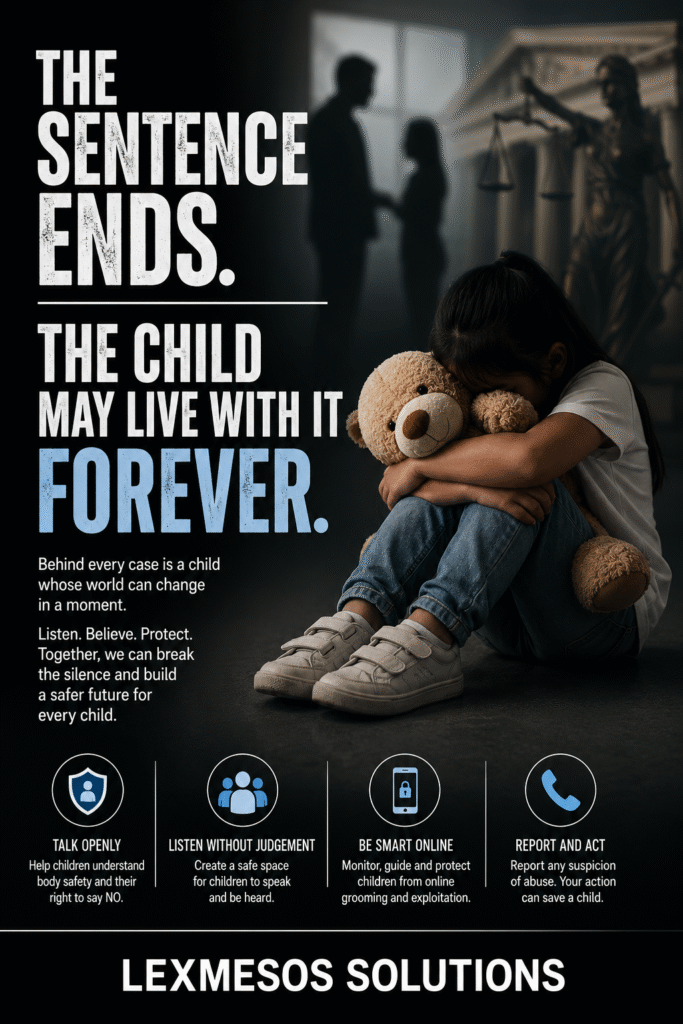
The Sentence Ends. The Child’s Story Continues.
This may be the most important point.
An offender can count the remaining days of a prison sentence.
A child cannot put a date on when a memory will stop hurting.
And where sexual images exist, there may be an additional fear that the material remains somewhere outside the child’s control.
That is why child sexual abuse cannot simply become another headline about an offender.
Parents need to talk to children about boundaries.
Schools and tuition centres need safeguarding systems.
Institutions need proper reporting mechanisms.
Police and prosecutors need the resources to investigate.
Technology companies need effective child-safety measures.
Courts must apply the law appropriately.
Governments need legislation capable of following offences across borders and technology.
And society needs to stop making children feel ashamed to speak.
Because ultimately the purpose of child-protection law should not simply be to punish someone after a child’s life has already been changed.
It should be to prevent that child from becoming a victim in the first place.
For the offender, the sentence may eventually end.
For the child, healing may take much longer.
And that is why protecting children must begin before there is ever a courtroom.
Keywords: Child sexual abuse, child sexual exploitation, child protection, child sexual abuse Malaysia, child sexual abuse Germany, sexual offences against children, child sexual abuse material, CSAM, online child sexual exploitation, child grooming, online grooming, sexual abuse of boys, child abuse by teachers, child safeguarding, child trauma, child victims, Sexual Offences Against Children Act 2017, Malaysia child protection law, Germany child protection, AI child safety, AI-generated sexual abuse material, deepfake child abuse, children online safety, parental awareness, child sexual abuse prevention, child exploitation laws, child abuse reporting, ECPAT Malaysia, children’s digital safety, and children’s rights
References:
DW- Germany Records Rise in Sexual Violence Against Children, July 2026
ECPAT International- The Sexual Exploitation of Children in Malaysia
South China Morning Post- Malaysia Closes Jurisdictional Gaps on Child Sexual Abuse, July 2026
Taipei District Court- Huang Tzu-chiao Case, Official Court Release
U.S. Department of Justice- Epstein Library (updated July 2026)
U.S. Department of Justice- Review of the Epstein 2006–2008 Investigation
Malay Mail- Seremban Counselling Teacher Case
The Sun/Bernama- Teacher Charged in Case Involving 13-Year-Old Male Student, June 2026
22 July 2026