 Skip to content

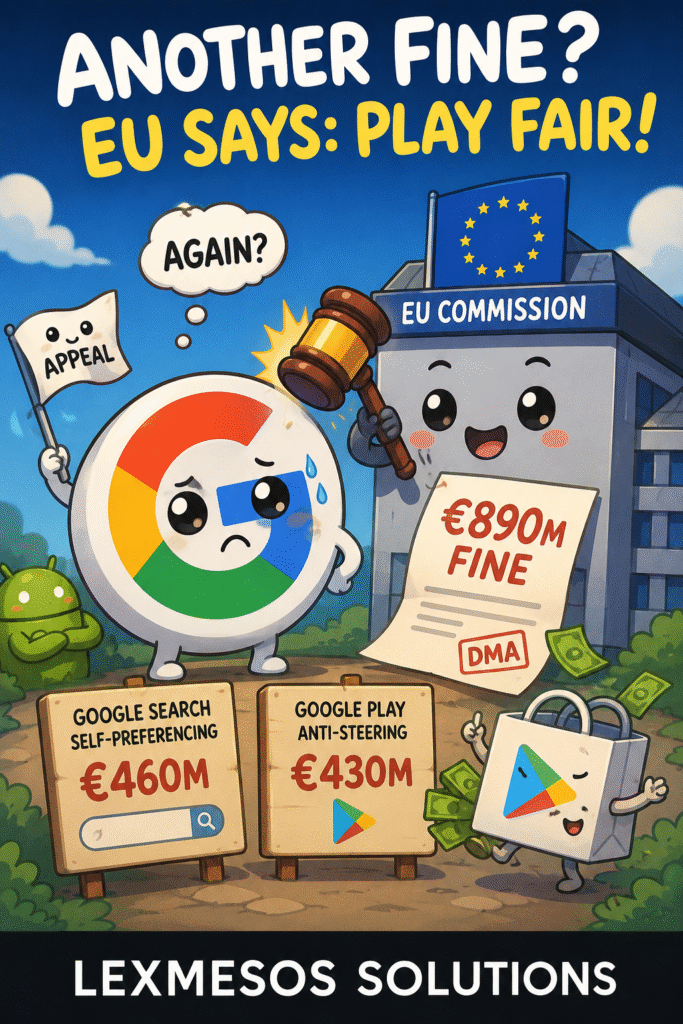
Google has been fined again.
And if that sounds familiar, it should.
Earlier this month, Google lost its final appeal over a €4.1 billion EU competition fine involving Android. Then came another European move aimed at opening Android to competing AI assistants.
Now, on 23 July 2026, the European Commission has fined Google another €890 million, this time over Google Search and Google Play.
Different cases. Different rules. Different Google products.
But they keep coming back to one surprisingly simple question:
How much control should one company have when billions of people and businesses depend on its digital ecosystem?
What Did Google Do This Time?
The €890 million is actually made up of 2 separate fines under the EU’s Digital Markets Act, commonly known as the DMA.
Google received:
€460 million over the way its own services appear in Google Search.
And another:
€430 million over restrictions affecting how app developers can direct customers to other purchasing options outside Google Play.
You don’t need to understand the DMA to understand either problem.
Let’s start with Search.
1. When Google Search Also Competes With the Businesses It Ranks
Imagine you own a huge shopping centre.
Millions of people enter your building every day looking for shops.
But you also own several shops inside that building.
Now imagine your shops consistently receive the best locations, bigger signs and greater visibility than competing shops.
That is roughly the problem European regulators see with Google Search.
The Commission says Google has been giving preferential treatment to some of its own services, including shopping, hotels, transport and sports results over competing third-party services.
Google can display its own services prominently, including at the top of search results and with enhanced visual features and filters that competitors may not receive in the same way.
The problem isn’t that Google owns other services.
The question is whether Google should be able to use its control over Search to give those services an advantage.
Think About How You Actually Use Google
Most of us don’t think about digital competition when searching online.
We type:
Hotels in Bangkok.
Flights to London.
Best restaurants nearby.
Running shoes Malaysia.
And we assume the results appearing prominently are there because Google considers them useful.
But Google is not always simply the referee.
Sometimes Google is also one of the players.
That’s where the problem becomes interesting.
If the company deciding which businesses get visibility also operates competing services, regulators want to know whether everyone is really playing on the same field.
The EU concluded that Google wasn’t meeting the DMA’s requirements.
Hence the €460 million fine.
2. Then There’s Google Play
The second issue is even easier to understand.
Imagine downloading an app through Google Play.
Inside the app, a subscription costs €12.
But the developer sells exactly the same subscription on its own website for €9.
Should the developer be allowed to tell you?
The EU says yes.
Under the DMA, developers distributing apps through Google Play should be able to tell users about alternative offers, including cheaper ones and direct customers towards those purchasing options.
The Commission found that Google’s rules prevented developers from freely communicating and promoting offers through distribution channels of their choice, including third-party app stores.
It also found that the level and duration of certain fees Google charged in connection with directing users elsewhere went beyond what it considered compatible with the DMA.
That resulted in another:
€430 million.
Add the two together:
€890 million.
But Didn’t Google Just Lose €4.1 Billion?
Yes.
And this is where today’s story becomes much more interesting.
On 2 July 2026, Europe’s highest court dismissed Google’s final appeal against a roughly €4.1 billion fine involving Android.
That case actually dates back to 2018.
European regulators found that Google had used contractual arrangements involving Android devices to promote Google Search and Chrome, including through pre-installation requirements and licensing conditions.
After years of appeals, the Court of Justice upheld the penalty earlier this month.
We covered that case separately because the bigger issue wasn’t simply the size of Google’s fine.
It was about what happens when a company becomes so important to a market that its business decisions can shape the choices available to everyone else.
Our previous analysis:
Google Lost €4.1 Billion. But This Case Was Never Just About Google.
And only 3 weeks later, Google has been fined again.
But These Aren’t the Same Case
This distinction matters.
The €4.1 billion Android case was a traditional EU competition law case.
Today’s €890 million penalties come under the much newer Digital Markets Act.
The easiest way to understand the difference is this:
Traditional competition law often asks:
Did a powerful company misuse its market position?
The DMA goes further by identifying certain enormous digital platforms as gatekeepers and imposing specific obligations on them.
In other words, regulators don’t necessarily have to wait for years to establish the same kinds of problems from scratch.
The rules tell gatekeepers upfront that certain behaviours are not acceptable.
Today’s decision is particularly significant because these are Google’s first fines under the DMA.
And Then There’s AI
Google’s regulatory problems are no longer limited to Search, Chrome or app stores.
Earlier this month, we also looked at another major development:
Could ChatGPT, Claude or another AI assistant eventually compete more directly with Gemini inside Android?
European regulators have been pushing Google towards greater interoperability between Android and competing AI assistants.
That matters because AI assistants could become one of the next major gateways through which people access information, services and businesses.
We explored that separately here:
Google May Soon Lose Control Over Your AI Assistant. Here’s Why
Now put these developments next to each other.
Android.
Search.
Chrome.
Google Play.
Payments.
Advertising.
AI assistants.
They are separate regulatory issues.
But together, they reveal something much bigger.
Europe is challenging Google’s control across several interconnected parts of the digital economy.
Why Does Google Keep Getting Fined?
This is perhaps the most interesting question.
Google became enormously successful because it built products people genuinely wanted to use.
Google Search became dominant because it was extremely useful.
Android became the operating system powering billions of devices.
Chrome became one of the world’s most widely used browsers.
Google Play became a major gateway for Android apps.
None of that is inherently wrong.
Being successful is not illegal.
Being big is not automatically illegal either.
The regulatory problem appears when one successful service can potentially be used to strengthen another.
Consider the ecosystem:
Google owns Android.
Google operates Google Play.
Google operates Search.
Google owns Chrome.
Google sells advertising.
Google operates shopping and travel-related services.
Google now operates Gemini.
When one company participates in so many connected markets, decisions made in one part of the ecosystem can potentially affect competitors somewhere else.
That is exactly why regulators keep returning to Google.
Nearly €10.4 Billion in EU Penalties
The numbers are becoming extraordinary.
Reuters reports that EU penalties against Google over roughly two decades now total about €10.38 billion.
That immediately raises another question:
If Google keeps getting fined, are the fines actually working?
For most businesses, even a fraction of these penalties would be devastating.
Google is different.
Alphabet operates at a scale where even billion-euro fines must be considered against one of the world’s largest technology businesses.
That doesn’t make the penalties insignificant.
But it explains why regulators increasingly care about something beyond the cheque.
They want changes to the underlying behaviour.
The EU Doesn’t Just Want Google’s Money
This part is important.
The Commission has ordered Google to end the 2 infringements behind today’s fines.
So this isn’t simply:
Google breaks rule → EU issues fine → Google pays → everyone moves on.
The real question is what happens next to Google’s products.
Reuters reports that Google and EU regulators are already engaged in what officials described as constructive discussions, while Google has been testing changes involving Search and Google Play.
Google disputes the Commission’s conclusions and argues that some required changes could worsen the user experience and unfairly favour certain competitors.
That means the next battle isn’t necessarily about another fine.
It is about how Google redesigns its ecosystem.
Does This Actually Matter Outside Europe?
Absolutely.
Imagine you run an app company in Malaysia.
Or an online travel business in Singapore.
Or an e-commerce company in Australia.
You may never read the Digital Markets Act.
But you probably care about:
Google Search visibility.
Android users.
Google Play distribution.
Google Ads.
AI assistants.
Changes to these platforms can affect businesses far beyond Europe.
Large technology companies sometimes introduce region-specific changes to comply with EU rules.
But European regulation can also influence global product design and inspire similar debates elsewhere.
This phenomenon is one reason businesses outside Europe increasingly pay attention to what Brussels does.
What Does It Mean for Ordinary Users?
For consumers, these regulatory battles may eventually affect something much more practical than legislation.
Choice.
You may see competing services presented differently in Google Search.
App developers may have greater freedom to tell you where you can purchase something more cheaply.
Android could become more open to competing AI assistants.
Alternative services may get opportunities that previously didn’t exist.
Whether all of those changes ultimately produce a better user experience is another question.
Google argues that some regulatory changes can actually make its products worse.
Regulators argue that competition should determine which services succeed rather than the company controlling the platform.
Both sides will continue making their case.
Is Europe Simply Targeting Google?
It’s a fair question.
Google is an American company and European regulators have repeatedly imposed enormous penalties on US technology companies.
Today’s decision has again created political tension with the United States.
But the EU’s stated position is not that Google should be punished because it is American or because it became successful.
The DMA is designed around the idea that certain very large digital platforms have become gatekeepers between businesses and consumers.
The regulatory argument is essentially:
If you control an important gateway, you shouldn’t be able to write all the rules in ways that benefit your own businesses.
Whether Europe has found the right balance between regulation and innovation is absolutely open for debate.
But the direction of travel is increasingly obvious.
This Is Bigger Than Google
Google makes the headlines because everybody knows Google.
But the broader debate affects the entire technology industry.
What happens when:
Amazon operates a marketplace while selling its own products?
Apple controls an app store while offering competing services?
Meta operates enormous advertising platforms while controlling access to huge audiences?
AI companies build assistants that increasingly decide what information users see?
The digital economy has created businesses that are simultaneously:
platform owner, competitor, distributor and gatekeeper.
Traditional business rules were not necessarily designed for that combination.
Governments are now trying to catch up.
Final Thoughts
Google keeps getting fined by Europe.
But the fines themselves are becoming the least interesting part of the story.
Earlier this month:
€4.1 billion- Android and competition law.
Then:
new pressure around Android and AI choice.
Now:
€890 million- Search and Google Play under the Digital Markets Act.
Look at each case separately and they appear to concern completely different products.
Look at them together and a much clearer picture emerges.
The real debate is about control.
Who decides what appears prominently when we search?
Who controls how apps reach consumers?
Who determines where users can pay?
Who decides which AI assistant gets access to our phones?
And what happens when the answer to all of those questions starts becoming the same company?
Europe’s answer appears increasingly clear:
The bigger the gateway, the harder regulators will look at how that power is being used.
Google’s challenge is therefore no longer simply paying another fine.
It is figuring out how to operate one of the world’s most interconnected digital ecosystems while regulators increasingly insist that competitors must also be given room to compete.
Build Better Digital Governance
Digital regulation no longer stays neatly within one country or one piece of legislation. Decisions involving major platforms can affect businesses, developers and consumers around the world.
LexMesos Solutions supports businesses with digital governance frameworks, compliance policies, internal procedures and practical documentation to help organisations understand and manage emerging digital risks.
Keywords: Google EU fine, Google €890 million fine, Google €4.1 billion fine, Digital Markets Act, DMA, Google Search, Google Play, Android competition law, Google AI choice, Gemini competition, Google self-preferencing, Big Tech regulation, EU digital regulation, digital gatekeepers, alternative app payments, app developer rights, platform competition, digital governance, competition law, Google Europe fines
References:
- European Commission- Commission fines Google €890 million for breaches of the Digital Markets Act
- Reuters- Google hit with $1 billion EU fine, in ‘constructive’ talks to avoid more penalties
- Court of Justice of the European Union- €4.1 billion Android judgment
- Reuters- Google loses final appeal over €4.1 billion EU antitrust fine
23 July 2026