 Skip to content

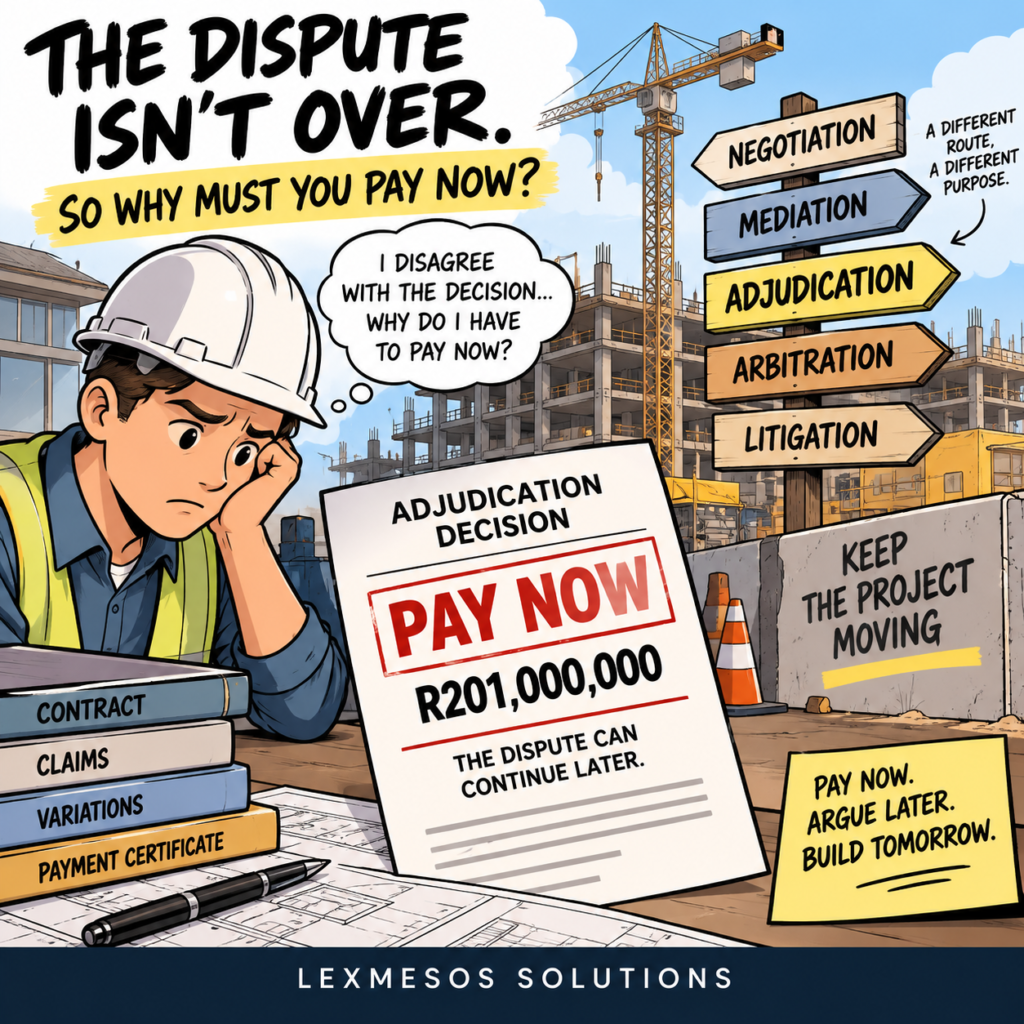
Imagine losing a construction dispute and being told to pay R201 million.
You think the decision is wrong.
You want to challenge it.
You are prepared to take the dispute to arbitration.
So why should you pay now?
That was essentially the problem before the Gauteng High Court in South Africa in September 2026.
The answer was uncomfortable but important: because the parties had already agreed how their disputes would work.
The adjudicator’s decision was binding in the meantime.
The fight could continue later.
The payment could not simply wait.
This is often called “pay now, argue later.”
But if you have never dealt with a construction dispute before, there is probably an earlier question:
What exactly is adjudication and why can someone who has not finally won the dispute still make you pay?
To understand that, we need to start with something much more familiar.
When There Is a Dispute, Do You Just Go to Court?
That is what many people assume.
Someone breaches the contract, you appoint a lawyer and eventually someone gets sued.
That is litigation, the traditional court process.
But a commercial contract may already provide another route.
Look towards the back of a construction contract and you may find provisions dealing with:
negotiation, mediation, adjudication, arbitration and litigation.
Collectively, processes outside traditional court litigation are commonly described as Alternative Dispute Resolution (ADR).
The terminology sounds complicated. The basic differences are not.
In negotiation, the parties try to settle the problem themselves.
In mediation, an independent mediator helps them try to reach an agreement. The mediator normally does not decide who wins.
In adjudication, an adjudicator actually makes a decision, usually within a much shorter period than a full arbitration or court case.
In arbitration, an arbitrator or tribunal hears the dispute privately and ultimately makes an arbitral award that is generally final and binding, subject to limited grounds for challenge.
And in litigation, the courts determine the dispute.
Your contract may use one of these methods.
It may also use several.
For example:
Negotiation → Adjudication → Arbitration
That sequence is much more important than it looks.
You May Have Decided How to Fight Years Before the Fight Started
When people negotiate construction contracts, they naturally concentrate on what matters commercially at that moment.
The price.
The scope.
Payment terms.
Variations.
Completion dates.
Extension of time.
Liquidated damages.
Performance bond.
Then somewhere among dozens or hundreds of pages sits the dispute-resolution clause.
Nothing has gone wrong yet, so it can feel remote.
Then a RM5 million progress claim is rejected.
Or the employer deducts liquidated damages.
Or a variation worth millions is not certified.
Suddenly everyone starts reading the dispute clause.
By then, however, the parties have already signed it.
You may already have agreed who decides the dispute, what procedure comes first, whether an interim decision must be obeyed and where the dispute ultimately ends.
That is exactly why adjudication matters.
Why Does Adjudication Exist?
Construction has a particular problem that ordinary litigation does not solve very well:
cash flow cannot always wait for the final answer.
Imagine a contractor halfway through a project.
A major progress payment is disputed.
Meanwhile, workers still need to be paid.
Subcontractors are waiting.
Suppliers want payment.
Materials have to be ordered.
Plant and machinery remain on site.
And construction is supposed to continue.
A final court case or arbitration may take considerably longer than the project can financially tolerate.
A contractor who eventually wins two years later may have suffered serious cash-flow damage long before that victory arrives.
Adjudication provides an interim answer much more quickly.
This is not a new idea.
One of the Cases That Helped Define Modern Construction Adjudication
In 1999, the English Technology and Construction Court decided Macob Civil Engineering Ltd v Morrison Construction Ltd [1999] EWHC Technology 254. (BAILII)
It was the first major English judgment considering the adjudication provisions introduced by the Housing Grants, Construction and Regeneration Act 1996.
The dispute concerned a subcontractor’s unpaid application for payment. The adjudicator directed payment of more than £300,000, plus VAT, interest and fees.
But there was a particularly interesting feature in the parties’ contract.
Although disputes could eventually go to arbitration, the contractual provisions said arbitration proceedings were not to commence before practical completion of the subcontract works or earlier termination, with further wording concerning final completion of the main works.
Think about what that could mean commercially.
A payment dispute could happen today.
The project could still have a long way to run.
Yet the final arbitration might not even begin until much later.
Adjudication filled that gap.
The court described adjudication as an intervening provisional stage in the dispute-resolution process. The adjudicator’s decision was intended to be binding in the meantime, while the dispute could ultimately be determined through arbitration, litigation or agreement.
That is the basic idea behind pay now, argue later.
The United Kingdom is no longer part of the European Union, but the same concept can also be seen within the EU.
Ireland: An EU Example of “Pay Now, Argue Later”
Ireland introduced statutory construction adjudication through its Construction Contracts Act 2013.
In Aakon Construction Services Ltd v Pure Fitout Associated Ltd [2021] IEHC 562, the Irish High Court described an adjudicator’s decision as provisionally binding and subject to summary enforcement. (BAILII)
The court used the expression that now captures the idea very neatly:
“pay now, argue later.”
The successful party can enforce the adjudication decision. The unsuccessful party can still pursue the underlying dispute through arbitration or court proceedings and, if ultimately successful, seek to recover an overpayment.
Ireland’s High Court returned to the principle in Connaughton v Timber Frame Projects Ltd [2025] IEHC 469. (Ireland Courts Service)
Again, the court explained that the default position is that the successful party can enforce the adjudicator’s decision on a provisional basis while the unsuccessful party retains the right to argue the underlying merits later through arbitration or court proceedings.
But that case also demonstrates an important limit.
Not every dispute can simply be pushed through adjudication.
The Irish statutory regime concerns qualifying payment disputes under construction contracts. If the dispute falls outside the statutory jurisdiction, “pay now, argue later” cannot magically create jurisdiction that the adjudicator never had.
That distinction becomes important when we return to South Africa.
South Africa: R201 Million to Pay While the Fight Could Continue
On 1 September 2026, the Gauteng Division of the High Court delivered judgment in China Coal No 5 Construction SA v Bakubung Minerals (Pty) Ltd and Others (2024/138173) [2026] ZAGPJHC 988. (SAFLII)
The parties had entered into an NEC3 contract relating to mining development, engineering and construction works at the Bakubung Platinum Mine Project.
Their contract contained a dispute-resolution mechanism involving adjudication and arbitration.
Disputes were referred to an adjudicator.
The adjudication award concerned approximately R201 million.
The employer did not comply.
The contractor went to court.
The employer wanted enforcement stayed and raised concerns that the contractor might not be able to repay the money if the employer ultimately succeeded.
There was a genuine commercial concern behind the argument. The employer alleged that the contractor had been established for the project, had no other ongoing South African operations and might not have sufficient assets to repay the money later.
The court still enforced the adjudication decision.
Why?
Because the contract provided that the adjudicator’s decision was binding unless and until revised by the tribunal and was enforceable as a contractual obligation.
The court emphasised that South African courts should be reluctant to interfere with an adjudicator’s determination where the parties have agreed that it will remain binding pending arbitration.
It also made another point that businesses should pay attention to:
An alleged error of fact, law or procedure does not ordinarily become a defence to enforcement.
In simple language:
“The adjudicator got it wrong” does not automatically mean “I don’t have to pay.”
The merits can be fought in the proper final dispute process.
The interim decision still has a job to do.
The court ordered the employer to give effect to the adjudicator’s decision, including payment of approximately R71.8 million in compensation events and R129 million in low-performance damages, together with applicable interest.
The orders were to remain effective unless and until the adjudication decision was revised through settlement or an arbitral award.
That is “pay now, argue later” in very real terms.
But South Africa also provides an important warning about the limits of that principle.
Courts May Be Reluctant to Interfere. That Does Not Give an Adjudicator Unlimited Power.
Only weeks before China Coal, the Western Cape High Court delivered its decision in City of Cape Town v Pro Khaya Construction CC (Appeal) (A28/2026) [2026] ZAWCHC 396. (SAFLII)
That dispute involved adjudication under a JBCC construction contract.
This time, the adjudication determination was held not binding and unenforceable.
Why?
The problem went to the adjudicator’s authority to decide what had been put before him.
The court found that matters had been determined that were not properly within the dispute referred for adjudication.
That is fundamentally different from saying: “The adjudicator considered the right dispute but reached the wrong answer.”
An adjudicator gets authority from the applicable contract and dispute-resolution framework.
If something was never properly referred, “pay now, argue later” cannot simply be used to expand the adjudicator’s jurisdiction.
So there are two very different arguments:
The adjudicator was wrong and the adjudicator was not entitled to decide this at all.
The distinction matters.
Malaysia Takes Us to Another Version of the Same Problem
Malaysia is particularly interesting because its adjudication system is different again.
The recent South African cases concern contractual adjudication.
Malaysia has a statutory regime under the Construction Industry Payment and Adjudication Act 2012 (CIPAA).
CIPAA was introduced to address payment disputes in the construction industry and provide a relatively fast adjudication mechanism.
A contractor does not necessarily need to wait until the entire project is completed before dealing with an unpaid progress claim through adjudication.
That is commercially important.
If payment stops halfway through a project, telling a contractor to wait for the final dispute process may completely miss the problem.
The money may be needed now.
But a CIPAA adjudication decision is not necessarily the final word on the parties’ underlying rights.
The dispute may still ultimately be determined through arbitration or litigation.
That is why Malaysian adjudication is often discussed in terms of temporary finality.
Temporary, however, does not mean optional.
Winning Adjudication Can Still Have Immediate Consequences
Under section 28 of CIPAA, the successful party can apply to the High Court to enforce the adjudication decision as if it were a judgment or order of the High Court.
So imagine this:
You lose the adjudication.
You disagree with the result.
You believe arbitration will eventually prove you right.
That does not mean you can simply put the adjudication decision in a drawer and wait for arbitration.
The winner may move to enforce it.
The losing party may pursue the underlying dispute through the appropriate final dispute process and, where the statutory requirements are satisfied, may seek a stay.
But the timing of those steps matters.
Malaysia’s Federal Court made that particularly clear in Econpile (M) Sdn Bhd v ASM Development (KL) Sdn Bhd and another appeal another appeal [2024] 3 MLJ 157 in 2024. (Lexology)
The case concerned the relationship between section 16, which deals with a stay of an adjudication decision, and section 28, which deals with enforcement.
The Federal Court held that where a valid enforcement order under section 28 had already been made, the adjudication decision could not subsequently be stayed under section 16(1)(b).
That is not merely a technical procedural point.
It carries a practical warning:
If you lose an adjudication, waiting to see what happens may itself have consequences.
The other party may already be taking the next step.
Does That Mean You Must Start Arbitration Every Time You Start Adjudication?
Not necessarily.
Adjudication and arbitration serve different purposes and whether parallel proceedings are appropriate depends on the contract, the dispute and the applicable law.
Nor is it correct to say that arbitration always has to wait until the entire construction project has been completed.
Some contracts may impose restrictions on when arbitration can begin. Macob itself is a useful historical example because its contractual provisions restricted the commencement of arbitration until later project stages.
Other contracts and disputes may permit arbitration earlier.
The important point is not that adjudication always comes first and arbitration always comes later.
The important point is:
Know what your particular contract says before choosing your next move.
Adjudication Is Not a Mini Court Case
This is probably the easiest way to understand the whole system.
Adjudication is designed to be quick.
That speed comes with a trade-off.
The adjudicator does not necessarily have the same time available as a judge conducting full litigation or an arbitral tribunal conducting a lengthy arbitration.
There can be extensive documents, technical issues, valuation disputes, delay analysis and competing contractual interpretations to deal with in a short period.
Mistakes can happen.
The system nevertheless places value on having an interim decision that the parties can act upon.
That is why courts in jurisdictions using these mechanisms have repeatedly recognised that enforcement proceedings should not simply become an appeal on the merits of the adjudicator’s decision.
If every losing party could stop payment simply by saying:
“The adjudicator misunderstood my evidence.”
or
“The adjudicator interpreted the contract wrongly.”
the entire purpose of rapid adjudication would disappear.
The final dispute mechanism exists to deal with the merits where the parties continue the fight.
So Why Would Anyone Agree to “Pay Now, Argue Later”?
Because the alternative can be worse.
Construction projects involve chains of payment.
Employer.
Main contractor.
Subcontractors.
Specialist subcontractors.
Suppliers.
Workers.
A major payment dispute near the top can affect everyone below it.
The industry therefore has a particular interest in resolving payment disputes quickly enough to keep projects and businesses moving.
Adjudication does not necessarily answer:
Who will ultimately win every issue in this dispute?
Sometimes it answers the more urgent question:
What needs to happen now while that bigger fight continues?
That difference is the whole point.
The Most Important Clause May Be the One You Barely Read
There is a broader lesson behind Macob, the Irish cases, South Africa’s recent R201 million dispute and Malaysia’s CIPAA regime.
When the contract is being negotiated, the dispute clause can feel like boilerplate.
When a serious dispute arises, it can determine almost everything that happens next.
It may determine:
-whether negotiation must happen first;
-whether adjudication is available or compulsory;
-which disputes can be adjudicated;
-how quickly a dispute must be referred;
-what documents have to be served;
-whether an adjudicator’s decision must be complied with immediately;
-how and when dissatisfaction must be notified;
-whether arbitration or litigation follows;
-whether those proceedings can run concurrently;
-whether a stay can be sought; and
-whether the court will enforce the interim result.
The commercial terms tell you how the project should work when things go well.
The dispute clause tells you what happens when they don’t.
And by the time you desperately need that clause, you have usually already signed it.
So before asking:
“How do we fight this?”
there is a better question to ask first:
“What did we already agree would happen when this fight started?”
Because sometimes the dispute is not over.
You may still go to arbitration.
You may still go to court.
You may ultimately prove that the earlier decision was wrong.
But depending on the contract and the applicable law, you may still have to pay now and argue later.
Keywords: Pay now argue later, construction adjudication, construction disputes, adjudication vs arbitration, ADR, alternative dispute resolution, arbitration, litigation, construction contracts, dispute resolution clause, adjudication enforcement, CIPAA Malaysia, South Africa adjudication, Ireland construction adjudication, UK construction adjudication, NEC3 disputes, and construction payment disputes
This article is for general information only and does not constitute legal advice. Adjudication, arbitration and enforcement procedures differ between jurisdictions and contracts. Parties facing an actual dispute should obtain advice based on the applicable contract and law.
22 September 2026