 Skip to content
“It’s a Good School.”
Parents hear this all the time.
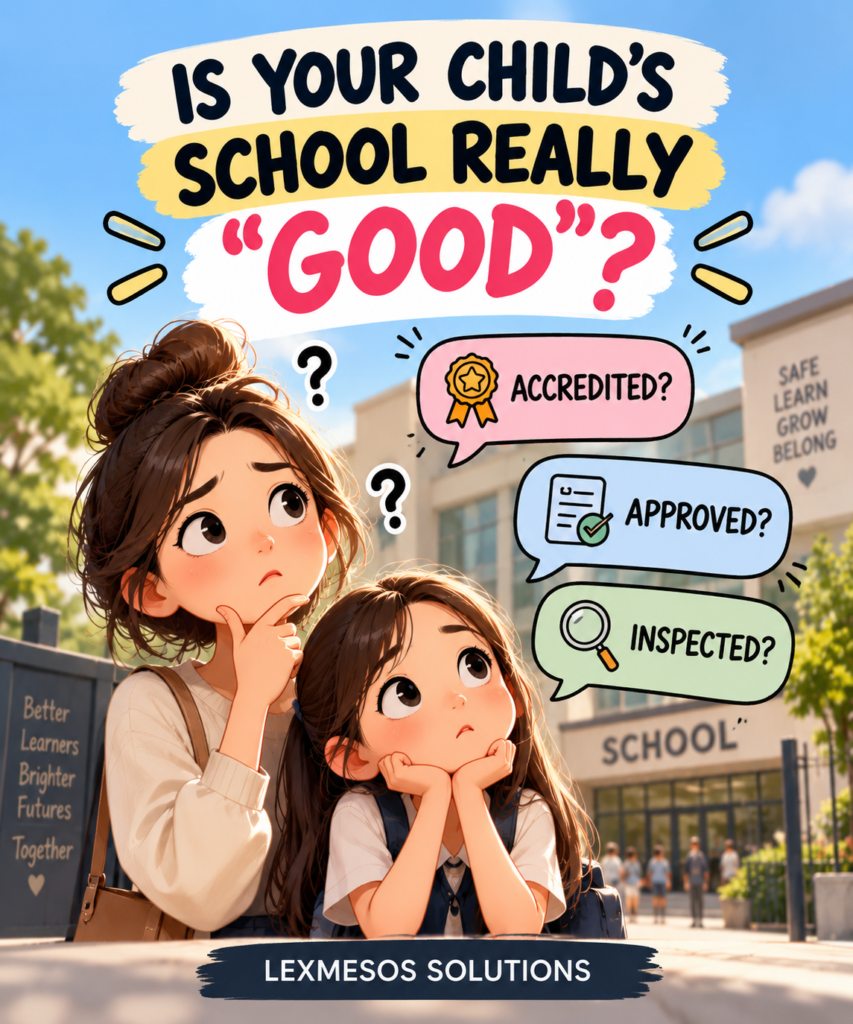
But what actually makes a school “good”?
Is it because it is government-approved? Inspected? Accredited? International? Well-known? Expensive? Or simply because other parents say it has a good reputation?
Whether a child attends a public school, private school or international school, parents are ultimately trusting an institution with a significant part of their child’s education and development.
Yet several words commonly used to reassure parents do not necessarily mean the same thing:
Registered.
Licensed.
Inspected.
Accredited.
Approved.
International.
British curriculum.
They may all sound reassuring, but they can refer to very different things.
The more useful question is not simply whether a school carries one of these labels.
Who awarded it, what exactly was checked, and what happens if the school later stops meeting those standards?
Registration, Inspection and Accreditation Are Not the Same Thing
Imagine three different questions.
Registration asks: Is this institution legally permitted to operate?
Inspection asks: Is the school meeting particular regulatory or educational standards when it is assessed?
Accreditation asks: Does the institution satisfy the standards established by a particular accrediting organisation or scheme?
The precise meaning varies considerably between jurisdictions and accreditation systems.
That is why seeing an accreditation badge on a school website should be the beginning of a parent’s enquiry, rather than the end of it.
Parents can reasonably ask:
Who awarded it? What standards were assessed? When was the school last assessed? How long does the accreditation last? Is there a published report? What happens if the school later falls below the required standard?
These questions become especially important in international education, where government regulation, curriculum providers and private accreditation systems may operate alongside one another.
Why Quality Assurance Exists
Quality assurance is not simply bureaucracy.
The OECD describes school evaluation as serving two major purposes: school improvement and school accountability. It can examine educational practices, student outcomes and compliance with rules and regulations. The OECD also emphasises transparency, including making evaluation criteria and procedures available and ensuring appropriate follow-up after an evaluation. (OECD)
That last part is important.
A school passing an assessment at one particular point in time does not mean that nothing can subsequently change.
Teachers leave. Principals change. Student numbers grow. School ownership may change. Policies may look impressive on paper but operate differently in practice.
Quality assurance therefore works best as a continuing process, rather than simply a certificate hanging on a wall.
The Parent Is Part of the Accountability System Too
Interestingly, greater parental choice itself has contributed to the importance of school accountability.
Parents themselves also look beyond academic results. OECD research found that, across participating countries, parents placed considerable importance on school safety, environment and reputation when choosing schools, alongside academic achievement.
This makes sense.
Parents are not buying an examination result.
They are entrusting an institution with a child for a significant part of that child’s formative years.
What Does an Inspection Actually Look At?
England provides a useful example of how extensive formal school oversight can become.
Under Ofsted‘s independent-school inspection framework currently in use from September 2026, inspectors assess defined areas of school provision. The underlying standards and evidence include matters such as safeguarding, leadership, pupils’ achievement and progress, including consideration of pupils who may face barriers to learning or wellbeing. (UK Government)
Importantly, Ofsted publishes its inspection framework and guidance (UK Government). Its information is intended not only for inspectors and schools but also for parents, carers and the wider public.
That illustrates an important principle of quality assurance:
It is not only the existence of an inspection that matters. Transparency about what was inspected matters too.
Malaysia: Being Registered Is Important But Understand What Registration Means
Malaysia provides another useful example.
The Ministry of Education states that private educational institutions are governed by the Education Act 1996 (Act 550). Its Private Education Division handles the establishment and registration of private educational institutions as well as enforcement and regulatory activities. (EduSwasta)
The Ministry’s current FAQ states that private educational institutions must be registered under section 79 of the Education Act 1996. (Kementerian Pendidikan Malaysia)
Registration itself involves practical requirements. Ministry information refers, among other things, to approvals concerning premises, fire and health requirements, information concerning teachers and employees, approved courses or subjects and required classrooms or laboratories.
All of this is significant.
But parents should still distinguish regulatory registration from other representations a school may make about international accreditation, curriculum recognition or educational quality.
A school saying “registered with the Ministry of Education” and a school saying “internationally accredited” are making two different statements.
Parents should understand both.
Cyprus: Approval and Inspection Again Have Their Own Meaning
Cyprus offers another useful comparison, particularly because of its sizeable private and international-school sector.
The Cyprus Ministry of Education states that private schools operate under the Private Schools Law of 2019, and that a private school cannot operate unless it has received the required ministerial approval following the prescribed process. (Cyprus Ministry of Education, Sport and Youth)
The Ministry also states that private primary schools are inspected and coordinated by Ministry officers.
But an international school operating in Cyprus might additionally advertise a particular curriculum, examination pathway, overseas affiliation or accreditation.
Again, these layers should not automatically be treated as interchangeable.
A school’s legal authorisation to operate answers one question.
An external accreditation may answer another.
Its examination arrangements may answer another.
And the day-to-day experience of children inside the school is yet another question.
So What Does “Accredited” Actually Guarantee?
The safest answer is:
Whatever that particular accreditation scheme says it guarantees, no more and no less.
There is no universal meaning of the word accredited that tells a parent everything about a school.
The useful questions are therefore not merely:
“Is this school accredited?”
but:
“Accredited by whom, against what standards, and with what continuing oversight?”
That small change in questioning can reveal a great deal.
A Beautiful Accreditation Badge Is Not an Inspection Report
School websites are marketing tools as well as sources of information.
Logos from educational organisations, examination bodies and accrediting organisations can understandably create an impression of institutional credibility.
But parents should look beyond the logo.
Check the accreditor’s own website rather than relying solely on the school’s description.
Check whether the school currently appears in the accreditor’s directory.
Look for the date of accreditation.
Find out whether accreditation is institution-wide or applies only to a particular programme.
See whether an inspection or evaluation report is available.
And, importantly, look at what happens between assessments.
The OECD stresses that systematic feedback and follow-up are important components of school evaluation; publication of external evaluation reports can also support improvement and accountability.
The question therefore should not simply be whether someone inspected the school five years ago.
It should also be:
What happened afterwards?
What Parents Can Check Before Choosing a School
A practical parent due-diligence exercise does not have to be complicated.
Before enrolling a child or when reviewing a school your child already attends, consider checking:
- Government registration– Is the school legally registered or approved by the relevant education authority?
- Accreditation– Which organisation actually accredits it?
- Scope– Does accreditation cover the entire school or only a programme?
- Current status– Is the accreditation still valid?
- Inspection history– When was the school last independently inspected?
- Reports– Can parents see the inspection or accreditation findings?
- Safeguarding– What procedures exist for protecting children and reporting concerns?
- Complaints– Is there a clear escalation process beyond the child’s teacher?
- Governance– Who ultimately oversees school management and accountability?
- Follow-up– If an inspection identifies weaknesses, who makes sure they are corrected?
Parents can also ask whether accreditation can be suspended or withdrawn and whether they would be informed if the school’s status changed.
Those questions often tell you more than the accreditation logo itself.
Accreditation Still Matters
None of this means accreditation or inspection is meaningless.
Quite the opposite.
Well-designed external evaluation can provide an important layer of accountability, while internal evaluation can help schools identify weaknesses and improve. The OECD describes school evaluation as a core part of accountability and emphasises the importance of clear standards, transparency and systematic follow-up.
But quality assurance works best when parents understand what it actually does.
An accreditation certificate should therefore create informed confidence, not unquestioning confidence.
The Question Behind the Certificate
Parents will naturally look at academic results, facilities, university destinations, extracurricular activities, class sizes and fees.
They may visit the campus.
They may speak to other parents.
They may read online reviews.
And somewhere on the school’s website, they may see the word:
ACCREDITED.
That is useful information.
But there should always be one more question:
Accredited for what, by whom and who is checking that those standards are still being met?
Because accreditation can tell parents that a school has satisfied a particular set of standards.
It should never replace the question every parent is entitled to ask:
What exactly was checked, by whom and what happens when something goes wrong?
Keywords: school accreditation, international school accreditation, school inspection, private school regulation, education quality assurance, parent school checklist, school governance, safeguarding, international schools, Malaysia private schools, Cyprus private schools, Ofsted independent schools
19 September 2026