 Skip to content
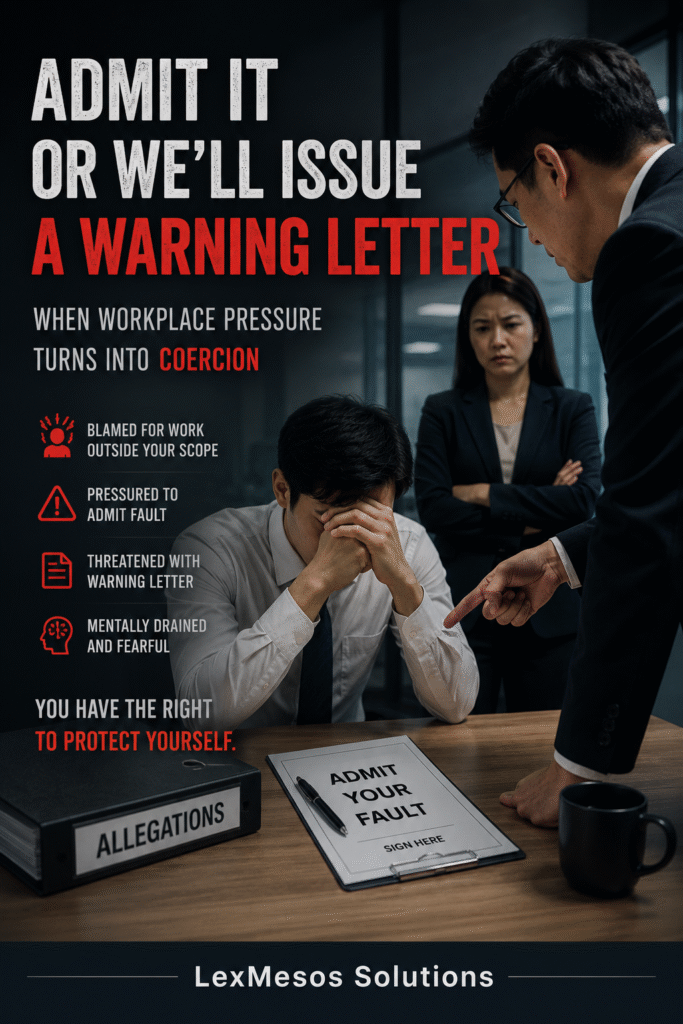
Not all workplace bullying happens through shouting.
Sometimes it happens quietly inside meeting rooms, HR discussions and closed-door conversations.
An employee gets called into a meeting.
Then suddenly:
- they are blamed for matters outside their expertise,
- pressured to “admit fault”,
- told to “just accept responsibility and move on”, or
- indirectly warned that refusing may lead to disciplinary action or warning letters.
For many employees, these situations become psychologically exhausting because they already feel outnumbered before the meeting even begins.
Sometimes the employee already realises:
- management has formed a conclusion,
- HR appears aligned with management,
- and the meeting no longer feels neutral.
That is why many employees later feel:
“The meeting was never truly for clarification.”
Some employees are not afraid of the allegation itself.
They are afraid of what happens after disagreeing with HR or management.
Because in real life, employees may fear:
- retaliation,
- worsening performance reviews,
- office politics,
- internal isolation,
- losing bonuses,
- career stagnation, or
- eventually being pushed out quietly.
This is one reason why workplace coercion discussions are becoming increasingly emotional online.
Many employees feel trapped between:
⚠️ protecting themselves
⚠️ protecting their income
⚠️ surviving internally
⚠️ avoiding further conflict
The difficult part is that many employees panic during these situations.
Out of fear, some immediately:
- apologise,
- accept blame,
- sign documents,
- agree to statements they later regret.
But once admissions are formally recorded, they may later become difficult to dispute internally.
This does not mean employees should avoid accountability where genuine mistakes happened.
However, there is a difference between:
reasonable workplace accountability and being pressured into accepting blame unfairly for matters outside one’s authority, expertise or decision-making scope.
In real life, many employees do not want to:
- argue aggressively,
- threaten legal action,
- or openly confront HR.
Because they still need to survive inside the company.
That is why many employees quietly try to protect themselves professionally through documentation instead.
Not emotional attacks.
Not hostile emails.
Just calm written records.
Because memories later become disputed.
Conversations become rewritten.
And verbal discussions may suddenly be remembered differently by different people.
Sometimes documentation becomes one of the few things employees still control.
This is especially important today because workplace disputes no longer stay private.
Internal emails, chat groups, Slack messages and workplace discussions can later become evidence in:
- disciplinary proceedings,
- HR investigations,
- unfair dismissal disputes,
- Industrial Court proceedings,
- or public workplace controversies online.
And increasingly, employees are beginning to speak openly about:
- coercive management behaviour,
- fear-driven office culture,
- internal politics,
- psychological pressure inside workplaces.
Because sometimes workplace bullying does not look dramatic from the outside.
Sometimes it sounds calm, procedural and “professional”,
while quietly pressuring someone into accepting blame they never truly believed was theirs.
Below is FREE TEMPLATE for a Follow-Up Email After a Difficult HR/Management Meeting
This is a general workplace communication example for informational purposes only and should be adapted according to individual circumstances.
Subject: Follow-Up On Discussion
Dear [Name],
Thank you for today’s discussion.
Following the meeting, I would just like to clarify that I may not have fully expressed myself clearly during the discussion due to the seriousness and pressure of the matters raised.
I would respectfully state that certain issues discussed were outside my direct expertise, authority and decision-making responsibilities. As such, I do not believe it would be accurate for me to accept full responsibility for those matters.
Nevertheless, I remain committed to cooperating professionally and carrying out my duties to the best of my ability moving forward.
I would also appreciate if this email could be kept together with the records relating to the matter discussed.
Thank you.
Regards,
[Name]
Useful Tips for Drafting Email
In REAL workplaces, if the tone sounds too legal, defensive, “I reserve my rights” or accusatory,
HR/management may immediately think:
⚠️ “This employee is preparing legal action.”
And once that happens, workplace politics can worsen. That’s why the MOST realistic survival-style email is usually:
✅ calm
✅ soft
✅ professional
✅ factual
✅ non-admission
BUT
✅ quietly recording position.
So, once again, many employees are not trying to “fight” their employers.
Sometimes they are simply trying to protect themselves professionally while surviving difficult workplace situations.
The reality is that not everyone can afford to:
- resign immediately,
- confront management aggressively,
- or escalate disputes openly.
That is why calm documentation often becomes one of the few things employees still control during workplace conflicts.
We hope this article and free template may help employees who are quietly struggling with workplace pressure protect themselves more carefully and professionally.
Keywords: workplace bullying, workplace coercion, warning letter pressure, toxic workplace, HR politics, unfair blame at work, hostile work environment, workplace intimidation, employee burnout, workplace mental pressure
22 May 2026