 Skip to content
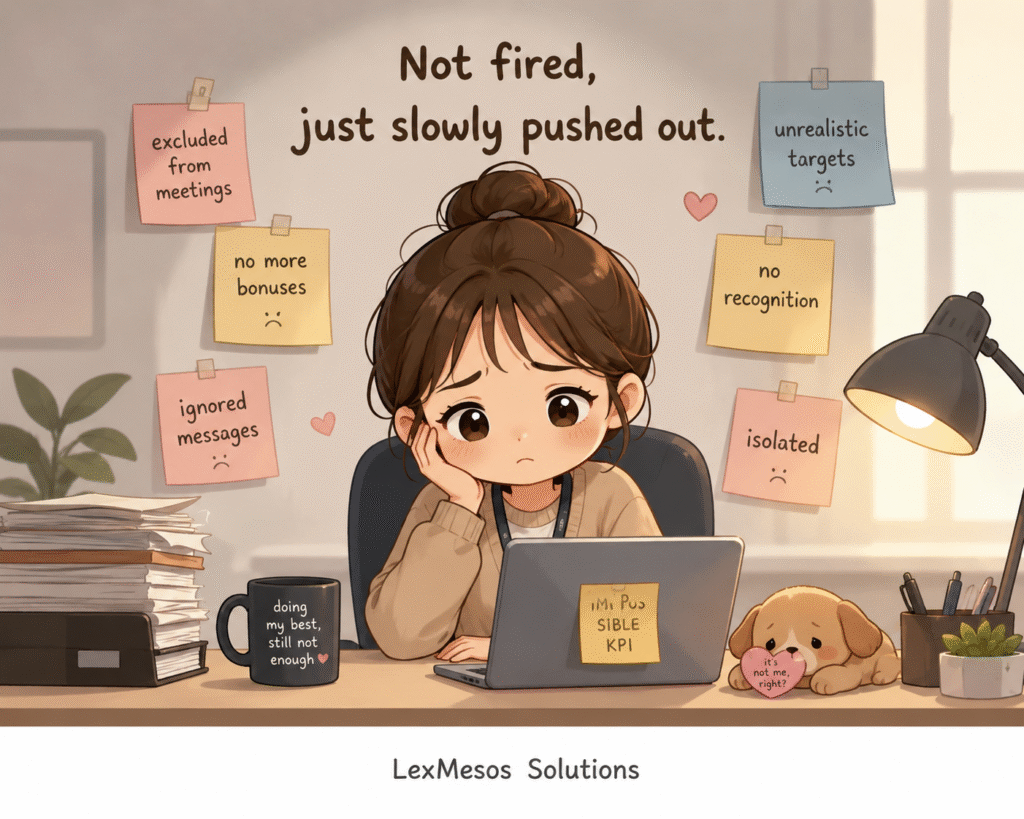
Not every employee gets officially fired.
Sometimes the company simply makes staying so difficult that the employee eventually gives up and resigns voluntarily.
This is what many people today call:
“quiet firing”.
It does not always happen openly.
There may be no termination letter.
No dramatic confrontation.
No official announcement.
Instead, things slowly start changing.
Suddenly:
- KPIs become unrealistic,
- bonuses disappear,
- performance reviews worsen,
- responsibilities get removed,
- meetings happen without you,
- promotions stop,
- management attitudes turn cold, or
- the employee starts feeling isolated inside the company.
Some employees describe it as feeling like:
“the company wants me gone, but wants me to resign myself.”
For employers, this can sometimes reduce:
- legal risk,
- compensation obligations,
- retrenchment costs,
- or internal conflict.
But for employees, the emotional pressure can become extremely draining.
The difficult part is that many employees cannot easily prove what is happening.
On paper, everything may still look “normal”.
The company may still say:
- “performance issues”,
- “business restructuring”,
- “management discretion”,
- or “changing operational needs”.
Meanwhile, the employee quietly feels pushed toward the exit.
This is why quiet firing discussions have become increasingly common globally.
Many employees are not imagining things.
They are noticing patterns.
Some employees suddenly receive impossible targets after years of stable performance.
Others find themselves excluded from projects or internal communication.
Some experience constant criticism over small issues that never mattered before.
And because financial survival comes first, many people tolerate the situation silently for months.
Not everyone can simply resign immediately.
People still need:
- salaries,
- healthcare,
- visas,
- family stability, and
- financial security.
That reality is what makes quiet firing psychologically exhausting.
The situation becomes even harder when employees feel internal systems may not fully protect them.
Some workers fear that:
- reporting concerns may backfire,
- HR may side with management, or
- performance evaluations may become even worse after speaking up.
Whether fair or unfair, these fears are increasingly part of modern workplace discussions.
Of course, employers still have the right to:
- manage performance,
- restructure teams,
- reduce costs, and
- maintain operational standards.
Not every difficult workplace situation automatically means quiet firing.
But there is a difference between:
reasonable management and creating conditions that slowly pressure someone to leave.
In Malaysia, employees who believe they were effectively forced to resign due to unbearable working conditions may sometimes explore constructive dismissal claims under employment and industrial relations frameworks.
However, real life is rarely simple.
Legal disputes can be:
- stressful,
- expensive,
- emotionally exhausting,
- and difficult to prove.
That is why many employees choose silence instead.
Some resign quietly.
Some mentally disengage.
Some continue pretending everything is fine until they eventually break down emotionally.
And increasingly, some turn to social media or public platforms to talk about what they experienced inside workplaces.
This is one reason why workplace culture is becoming a much bigger governance issue globally.
In the past, toxic management styles often stayed hidden internally.
Today:
- screenshots spread quickly,
- workplace chats become evidence,
- employees speak publicly,
- and reputational damage can escalate fast.
A company may survive poor quarterly performance.
But rebuilding employee trust after a toxic workplace reputation is much harder.
Because people usually do not leave jobs overnight.
Many leave after feeling emotionally pushed out for a very long time.
Keywords: quiet firing, toxic workplace, constructive dismissal Malaysia, employee burnout, HR politics, workplace pressure, impossible KPI, hostile work environment, unfair dismissal Malaysia, workplace governance
21 May 2026