 Skip to content
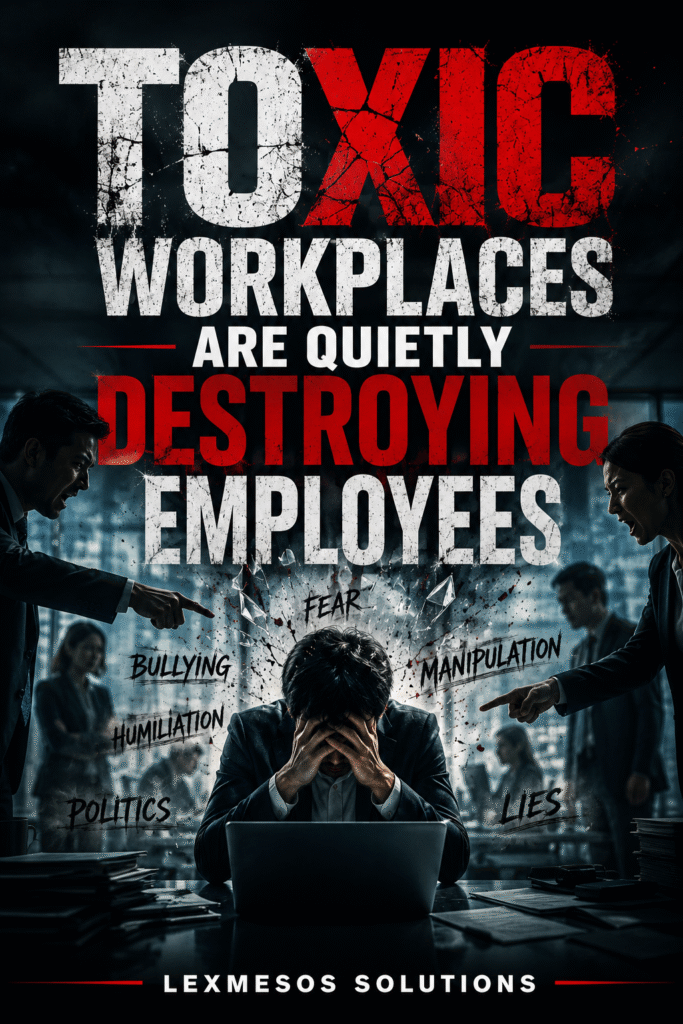
Many Employees Are Not Staying Silent Because Everything Is Fine. They Are Staying Silent Because Survival Comes First.
For years, toxic workplace culture was often brushed aside as:
“normal office politics” or “part of working life”.
Employees were expected to tolerate:
- humiliation,
- shouting,
- bullying,
- favouritism,
- fear-based management,
- excessive pressure, and
- unhealthy internal politics.
If someone complained, the response was often simple:
“Just resign if you cannot handle it.”
But reality is not that simple.
Not everyone can afford to walk away from a job immediately.
People have:
- rent,
- loans,
- children,
- visas,
- medical expenses,
- aging parents, and
- financial responsibilities.
Many employees stay silent not because they are happy.
They stay because survival comes first.
That is why toxic workplace discussions have become increasingly emotional online. Many people are not reading these stories as outsiders.
They are reading them from personal experience.
The recent Malaysian Industrial Court case involving American Express Malaysia attracted attention for exactly this reason.
According to reports, the Industrial Court awarded RM153,200 to a former employee in a workplace dispute involving allegations linked to a hostile work environment and wrongful dismissal.
For many readers, the story did not feel shocking.
It felt familiar.
Because many employees already understand how workplace politics can operate in real life.
Sometimes employees are not afraid of the workload.
They are afraid of what happens after speaking up.
Some employees say that once concerns are raised internally:
- performance reviews suddenly change,
- management attitudes become colder,
- opportunities quietly disappear, or
- the employee somehow becomes labelled as “aggressive”, “problematic” or “difficult”.
In some workplaces, employees feel trapped between staying silent and risking retaliation.
This is also why many people no longer fully trust internal reporting systems.
Some employees believe HR departments genuinely help solve problems.
Others believe HR mainly exists to protect management and minimise corporate risk.
Whether fair or unfair, this perception itself has become part of the modern workplace discussion.
The issue is not limited to Malaysia.
Globally, major corporations have faced public scrutiny over workplace culture problems.
Uber became one of the most widely discussed examples after former engineer Susan Fowler publicly described alleged harassment, retaliation and internal HR failures. The controversy eventually led to investigations, leadership pressure and major reputational damage.
Activision Blizzard also faced lawsuits and investigations involving allegations linked to hostile workplace culture, discrimination and harassment claims.
Tesla has similarly faced lawsuits involving allegations of racial harassment and hostile work environments.
Interestingly, even some business leaders have openly criticised traditional corporate HR structures.
Whether people agree or disagree with such views, the discussion itself reflects a growing distrust many employees feel toward workplace systems.
And that distrust is becoming more visible publicly.
The internet has changed workplace disputes completely.
In the past, toxic office behaviour often stayed hidden inside meeting rooms and private conversations.
Today:
- screenshots spread online,
- internal chat messages become evidence,
- whistleblower posts go viral, and
- workplace disputes quickly become public discussions.
A toxic workplace today is no longer just:
“an internal HR problem”.
It can become:
⚖️ a legal dispute
📉 a reputational crisis
💰 a financial risk
👥 a talent retention problem
🌐 a public relations issue
Digital workplace communication has also made situations more dangerous.
Internal chats, Slack channels, WhatsApp groups and workplace forums can easily become evidence later.
In some situations, employees who raise concerns may later find themselves being labelled internally as:
- liars,
- emotional,
- unstable,
- disloyal, or
- attention seekers.
And once workplace accusations move into digital spaces, the damage can escalate very quickly.
This is why workplace governance today is no longer only about policies written inside employee handbooks.
It is also about:
- power,
- accountability,
- leadership behaviour,
- communication culture, and
- whether employees genuinely feel safe speaking up.
Of course, employers still have every right to:
- manage performance,
- enforce discipline, and
- maintain operational standards.
But there is a difference between:
high performance culture and fear-driven workplace culture.
People can tolerate stress for a while.
But constant humiliation, intimidation and psychological pressure eventually wear people down.
Many employees are no longer burning out quietly.
Some are breaking down silently while pretending everything is fine at work.
And as economic pressure, AI-driven productivity demands and leaner workforces continue increasing globally, workplace culture may become one of the biggest corporate and social discussions of the next decade.
Because sometimes the biggest threat inside a company is not external competition.
It is the culture quietly developing inside the office itself.
Keywords: toxic workplace culture, workplace bullying, hostile work environment, HR politics, toxic boss, workplace harassment, employee burnout, corporate governance, workplace mental health, wrongful dismissal Malaysia, toxic management, workplace retaliation, Industrial Court Malaysia, American Express Malaysia case, HR compliance Malaysia, employment law Malaysia
20 May 2026