 Skip to content

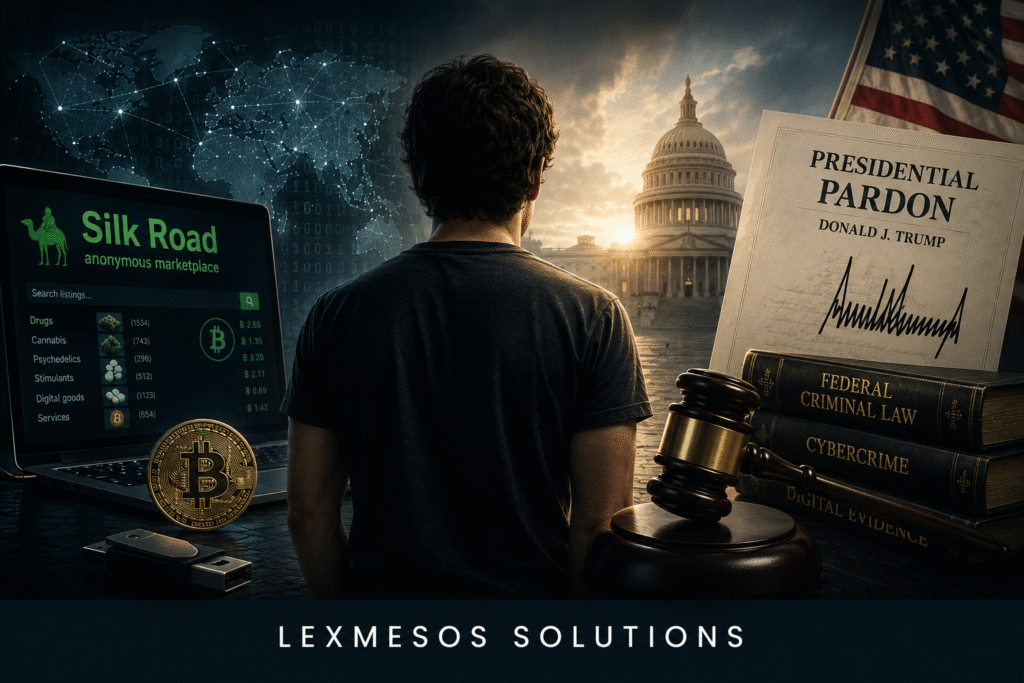
A website.
No physical office.
No storefront.
No employees serving customers.
Just a website.
Yet it became one of the most infamous online marketplaces in history.
Its creator, Ross Ulbricht, was convicted for operating Silk Road, a darknet marketplace that facilitated the sale of illegal drugs and other illicit goods using Bitcoin. In 2015, he was sentenced to 2 life sentences plus 40 years without the possibility of parole (U.S. Department of Justice).
Almost a decade later, in January 2025, President Donald Trump granted Ross Ulbricht a full and unconditional presidential pardon (BBC).
For some, he became a symbol of excessive punishment.
For others, he remained responsible for creating a platform that enabled serious criminal activity.
Regardless of where opinions differ, one lesson remains clear.
Technology does not exist outside the law.
The Website Was Never The End Of The Story
Silk Road disappeared years ago.
But the legal questions it raised are more relevant today than ever.
When does a platform become responsible for what happens on it?
Can technology creators be held accountable for how others use their products?
Where should the line be drawn between innovation and responsibility?
Those questions didn’t disappear with Silk Road.
They have simply evolved.
Today’s Risks Look Different
Today, businesses are embracing:
- Artificial intelligence
- Cryptocurrency
- Online marketplaces
- Cloud platforms
- Automation
These technologies create enormous opportunities.
They also create new legal and compliance risks.
An employee uploads confidential company information into an AI chatbot.
A marketplace unknowingly allows counterfeit goods to be sold.
A cryptocurrency platform becomes a target for money laundering.
A cybercriminal uses AI to launch sophisticated phishing attacks.
Technology changes.
The legal questions remain remarkably similar.
Compliance Is No Longer Optional
Many organisations still believe compliance is something to think about only after something goes wrong.
By then, it is often too late.
Effective governance starts much earlier.
Businesses should understand:
- What technologies they use.
- What risks those technologies introduce.
- Whether appropriate cybersecurity measures are in place.
- How sensitive information is protected.
- Whether employees understand their responsibilities.
Compliance is not about slowing innovation.
It is about ensuring innovation is used responsibly.
The Biggest Lesson
The Silk Road story is no longer just about Ross Ulbricht.
It is a reminder that technology can transform industries, but it can also create risks that businesses, regulators and society must address.
Artificial intelligence will continue to evolve.
Cryptocurrency will continue to evolve.
Cybercrime will continue to evolve.
The law will continue trying to keep pace.
The organisations that succeed will not simply adopt new technology.
They will also build the governance, cybersecurity and compliance frameworks needed to use it responsibly.
Because history has shown one thing repeatedly:
Technology moves fast.
The law eventually catches up.
Using AI Or Digital Technologies In Your Business?
Artificial intelligence, digital platforms and emerging technologies are transforming how organisations operate. Managing legal, cybersecurity and compliance risks is becoming just as important as embracing innovation.
Discover how LexMesos Solutions helps organisations strengthen AI governance, compliance and technology risk management for an evolving digital landscape.
Keywords: This article discusses Ross Ulbricht, Silk Road, the presidential pardon, cybercrime, cryptocurrency, Bitcoin, darknet marketplaces, AML, KYC, cybersecurity, digital evidence, platform liability, artificial intelligence, AI governance, compliance, risk management and corporate governance
This article is provided for general informational purposes only and does not constitute legal advice.
26 June 2026